

Duel Decks- Jace vs Chandra: Chandra’s Deck Review (Part 2 of 2)

I have to admit before writing these reviews, when I’d played the Jace/Chandra decks (usually against other Planeswalker-based Duel Decks) I’d tended to favour Chandra’s construction. Although in my heart I’m a Blue mage, it took deconstructing Jace’s composition to really get a sense of appreciation for its intricacy. Indeed, I suspect I began to second-guess Chandra’s, and so it was with a keen enthusiasm that I threw down the gauntlet to Sam, and squared off to see if a Red blitz could power through her early stalling. Here’s how it unfolded:

Duel Decks- Jace vs Chandra: Jace’s Deck Review (Part 2 of 2)
Having written up reviews for both the Jace and Chandra decks prior to our first playtest, I have to confess I was slightly in favour of Chandra’s offering. It just seemed faster (of course) and a bit more consistent than Jace’s, with a much more reasonable mana curve. But to find out whether or not my suspicions were borne out, I sleeved up the deck and went head-to-head with Sam, who piloted the Chandra deck. Here are the notes and results of the game.
Game One
Although I have reservations about a 2-land opener in a slow-build deck, I keep the starting draw here in the hopes that what protection it does afford me (a Daze and a Wall of Deceit) will provide the stall I need to start locking down the board. Besides, the Ancestral Vision will give me a much-needed shot in the arm on turn 4. After Sam plays her opening Mountain and passes, I drop the Vision onto the table and pass back.
Sam again lays a Mountain and passes. I drop a second Island and put down an un-Morhped Wall of Deceit. To my understanding, back when damage was on the stack these walls had a little more trickery to them (block with the 2/2 Morph, then respond to the damage by un-Morphing into the 0/5 wall while still dealing the damage- voila!), but for my purposes now a wall’s a wall.
Sam’s still in draw-go mode for turn 3, but concerningly I haven’t drawn into any more land and miss my third drop, playing a Martyr of Frost. Sam’s patience pays off when she unveils a fourth-turn Furnace Whelp. I consider Dazing it, but pass- I’ll need every land drop I can, and figure I’ll have an answer before long. But when Sam passes to me and I draw, still no third Island.
I hardcast the Daze on turn 5 to deny Sam the services of Chandra Nalaar, and she comes in for 2 damage with the Whelp. As my turn begins, the Visions comes out of Suspend and at last I draw a third land! I drop it, and play another Suspend card- this one a Riftwing Cloudskate.
Still hampered by resources, I am powerless to prevent Sam swinging in hard the next turn with a pumped up Whelp for 5, then bringing out a Soulbright Flamekin. Down to 13, I cast a Man-o’-War to bounce the damnable Whelp back to hand and hold the Flamekin at bay. Next turn, Sam recasts it, and adds a Seal of Fire for good measure. Passing to me, I push my Man-o’-War into the red zone for 2, dropping a land down and passing. By now I’ve managed to get up to five land, and Sam’s taking no chances with a counter, engaging the Seal to snipe my Martyr of Frost. She dumps six mana into the Flamekin, which refunds her eight, and pumps the Whelp up as she swings in with it, saving just enough mana to drop a second Whelp. I tap two and show Counterspell.
Down to 6 life and flailing about, my Cloudskate emerges from Suspend on turn 8, and again the Whelp is bounced to Sam’s hand. I summon a Mulldrifter after attacking for four. Sam’s down to 14.
Turn 9 finally breaks my back. Sam turns land sideways and lays down the Furnace Whelp, a Flamewave Invoker, and then Firebolts the Cloudskate for good measure. Desperate, I set out a Morphed Willbender, then Sam kills it and the Man-o’-War with a Cone of Flame, pinging me for 1 for good measure. In desperation I Evoke a Mulldrifter, and when I draw into an Island and a Mind Stone, I can only concede.

Game Two
Now on the play, I get off to another slow start characteristic of the deck, laying a land and passing for my first two turns. Sam threatens early with a Flamekin Brawler followed by a Pyre Charger, but she’s stymied on turn three when I bounce the Charger back to hand with a Man-o’-War. Passing to Sam, she plays an Oxidda Golem and swings in with it. I find the trade acceptable and swap it for my Man-o’-War.
Turn 4 arrives, and I’m able to deploy my Fledgling Mawcor, which should keep her Charger safely in hand. Sam responds by playing an Inner-Flame Acolyte and swinging in with it for an early 4. My Mawcor goes into the red zone on turn 5, then I summon a Mulldrifter who tops my hand up. But the momentum swings right back the other way when Sam snipes my Mulldrifter with a Flametongue Kavu.
By turn 6 I still haven’t missed a land drop, and take advantage of my good fortune by playing a Spire Golem for three, then deploying a Morphed Fathom Seer. Passing to Sam, she goes aggressive- resummoning the Pyre Charger then swinging in with everything except the poor Brawler. The board clears out as her Charger is killed by the Spire Golem while the Mulldrifter and the Kavu trade. I un-Morph the Seer and use it to block the Acolyte- neither dies.
Things quiet down over turns 7-8 as we both drop some land and refill our hands, the Spire Golem going about its merry way whittling down Sam’s life total. We’re even at 16 on turn 7, and Sam slips behind the next turn. Having had enough of the Golem, Sam chains together a Seal of Fire and Magma Jet to take it out. The damage comes to an end.
I Gush on the end of turn 9 to fish for options, and come up with another Spire Golem and an Ancestral Vision. Sam comes in at last with the Flamekin Brawler and I accept the trade for the Golem. The board is nice and clear and the game’s going long, which I know should play right into the strengths of Jace’s deck. A couple more turns pass before there’s any activity other than drawing and playing land.
On turn 13, Sam emerges from her cocoon and plays out a Soulbright Flamekin and an Ingot Chewer. But I’ve drawn into Guile with some countermagic and plenty of land to support him, and he comes out the next turn. Sam goes for broke and Demonfires Guile, but a Condescend thwarts her ambition. She tries again the next turn (after Guile pays her back for 6, taking her to 8), starting with a Fireblast. Again, though, I’m ready with the Condescend, and I blast her with 4 to the face (courtesy of Guile’s ability). She had an Incinerate ready as a follow-up, but with the Fireblast squandered and at 4 life, she scoops.
Game Three
The tiebreaker game, Sam opens with a Keldon Megalith, and I with an Island. She similarly has no turn 2 play aside from land, and I drop a Wall of Deceit. Sam’s ready the next turn, though, as a Flamewave Invoker hits the table, while my response is to play a Morphed Willbender, but the poor fella takes a Firebolt next turn. Avenging my fallen comrade, I trot out the reliable Man-o’-War and bounce her Invoker.
Turn 5, and Sam recasts the Invoker. Her loss of momentum, though, is telling- my play is an Air Elemental. I had the chance to cast a Waterspout Djinn on turn 4, but thought I’d wait and get out the more expensive one first so that the Djinn’s drawback wouldn’t prevent me from getting both in the air. I needn’t have worried overmuch, Sam starts turn 6 off with Chandra Nalaar, and she burns down the Elemental.
Undaunted, I deploy both the Djinn and a Spire Golem- with five Islands in play the 2/4 Flying Golem is a steal at one mana. Sam responds with a Chartooth Cougar, and pings me for 1 to build up Chandra. It’s the first point of damage the game has seen so far.
She passes turn, and I make an absolutely abysmal misplay. So dreadful, in fact, that the full wretchedness of it would only occur to me later (typing up this article). Short version is this: I needlessly sacrifice my Djinn. For those who may wish to engage in a little Schadenfreude, here’s the longer version:
Sam had some nasties on the board and her Planeswalker in play. I went to untap, and my eyes settled on the Djinn for a moment. I haven’t seen the card since Visions a long time ago, and I never cared for it then, but had not noticed in casting it that the Island I needed to return to my hand every turn had to be untapped- I’ve been much more accustomed to the Living Tsunami variant. I cursed myself for a fool in not leaving one open, instead ‘getting greedy’ and playign the Spire Golem with that last land instead. I was furious with myself for making such an obvious mistake, put the Djinn in the dustbin and continued on with the game.
Only now as I write this, though, did the full stupidity of my play reveal itself. Since the Untap phase comes before Upkeep, I could easily have satisfied the demands of the card, pulled an Island back to my hand and kept the Djinn in play. So in mistakenly thinking I’d made a stupid mistake, I committed an even stupider one. Goes to show that no matter how experienced the player, the brain indeed sometimes shuts off.
So with the Djinn gone, I’d put myself in dire straits indeed. I send in the Golem for 2 on Chandra, taking her down to 1 Loyalty, then play a Mulldrifter. Sam dispatches the Mulldrifter the next turn with a Seal of Fire, then swings large. I chump the Cougar with my Wall of Deceit, electing to take 2 from the Invoker. Chandra pings me for another, and I’m at 16 life. Sam passes turn.
Taking advantage of her aggression, I swing in on Chandra with both the Golem and the Man-o’-War. The Golem eats a Flameblast and dies, but the jellyfish gets there and Chandra’s gone. I then play another Wall of Deceit (un-Morphed) and a Morphed Voidmage Apprentice, then pass back to Sam.
Turn 9, and Sam firmly has the momentum. The Cougar is the main threat, as she swings in again with it and the Invoker. My second Wall goes the way of the first, and I take another 2 from the Invoker. Clearly, I need and answer, and soon. With 4 power before Firebreathing, it only needs to get in twice to kill me.
I have a Repulse in hand, and a secret counterspell in the form of the Morphed Voidmage Apprentice, but if I want to try and bounce the Cougar back to her hand and then counter it coming in, I need one more Island (I only have six in play). Feeling hopeful, I tap three and Repulse the cat back to her hand. Repulse cantrips, but no luck, so I must resort to Plan B. I cast Gush, returning two Islands back to my hand and drawing two cards (one of them being an Island, of course). Having not played a land this turn, I drop one down. Ta-daa, four Islands untapped.
As expected, Sam tries recasting the cat on turn 10, and the Apprentice un-Morphs and takes it out. Mission accomplished, I begin to feel like I can relax again. Sam sends in the Invoker anyway, and I gladly trade it for the Man-o’-War. On my turn, I peck her for 1 with the now-revealed Apprentice, and play a Brine Elemental. I don’t have enough mana to play him Morphed and reveal him in the same turn (sorely tempting as she’s tapped herself out), and I decide having a big body is the more useful play here. Sam renders the matter academic on turn 11 with a Demonfire.
A Fact or Fiction at the end of her turn on turn 12 nets me a Jace Beleren, who comes down immediately once her turn is done. Having survived the rush, the game should be mine to win now, and when I cast a Quicksilver Dragon the next turn with counter support, the end appears inevitable. Sam’s final act is one of pure spite: killing Jace with an Incinerate, a fitting conclusion to our spirited contest.
Final Analysis
As illustrated above, there’s a strong correlation when playing Jace between length of game and outcome. In the first game, Sam put some pressure on early and never relented, and even once my mana situation corrected itself I was already behind in the stalling tactics. In the last two, I was able to get the stall out early, and by midgame her momentum was generally fading while Jace started putting the squeeze on her. This played out exactly as expected.
What was not as expected, though, was Jace’s mana situation. The large spike at the tail-end of the mana curve was greatly worrying, but in actual practice it seemed to be somewhat mitigated by the evening-out effect of extra card draw. Be it through the Mulldrifters, Gush, a Fathom Seer or Jace himself, I was often able to keep my land drops consistent much later than I’d normally expect. In games 2 and 3, I in fact missed only a handful, and this made all the difference (even taking into consideration playing ‘returned’ land from Gush’s alternate casting cost or the Seer’s un-Morphing).
Although there are enough expensive cards lurking throughout the deck that the occasional dreadful draw is going to occur, the extra card drawing should give you some confidence in shipping the opener back for a mulligan- chances are, you’ll be making up that lost card (and more) as the game progresses.
In flavour the deck strikes a balance between control and beats. I had recourse to countermagic about half the time- just frequently enough to blunt some of the more dangerous plays Sam made, but not enough to actually lock her down or even make her gun-shy for casting. Still, the object of Jace’s deck is less in taking control of the board, and more in just slowing things down, keeping your opponent’s tempo and pace at a minimum through a few counters and bounces, before really establishing dominance through a large beater.
I actually didn’t think I’d have as much fun as I did playing Jace’s deck. It’s plain that a lot of thought went into crafting this one, and as a “control” deck even aggro players can enjoy it’s well worth tracking down.
Pros: Intricate design that supports its strategy well; two copies of the original Counterspell let you remember what the ‘good old days’ of Blue control were like; very well matched against the Chandra deck; lots of moving parts keep you from falling into “draw-go” monotony; very fun to play
Cons: High spike in the mana curve at the 5+ CMC level can make for some unwieldly opening hands; very vulnerable in the early game (this, however, is likely by design)
FINAL GRADE: 4.6/5.0
Exclusive: Ultra Pro Releasing Archenemy Deck Boxes

Are you a fan of the Ultra Pro licensed Deck Boxes, such as those released for the Duel Decks and Planechase?

Quick, go do a Google search for Archenemy + “Ultra Pro,” and you’ll find… a thread on the Mothership. Another on MTG Salvation. Some ads for oversize sleeves. An article on Ertai’s Lament (surprised us, too). And plenty of crickets chirping.
So far, word on the street’s been mum about any special release for Archenemy, but you heard it here first: an Archenemy deck box release has been officially confirmed today by Ultra Pro to Ertai’s Lament due for release this Autumn.
No word yet on a final release date or what they will look like, but we’ll be at the front of the line when they’re out (at risk of sounding like a shill, Ultra Pro is the ‘official’ Ertai’s Lament deck archival supplier of choice).

Duel Decks- Jace vs Chandra: Chandra’s Deck Review (Part 1 of 2)

As previously covered, Jace’s deck in the Duel Decks package was subtle and complicated, well-befitting the character Wizards has created in the Planeswalker. Not surprising, then, to find that the deck of his foil, Chandra, is is many ways quite the opposite. Although it is something of a cliche to say that burn decks are simpleton affairs, it certainly cannot stack up to the mono-Blue deck in terms of complexity and options. To some it may be refreshingly straightforward that Chandra’s deck is designed mainly to smash face with beaters and clear a path with burn. In many ways, what you see is what you get with the fiery, impulsive Chandra.
A Burning Ring of Fire
Let’s start with the array of creatures. A look at the curve graph shows a much more balanced spread than was present in the Jace deck, and with good reason- Red never wants a game to go long.
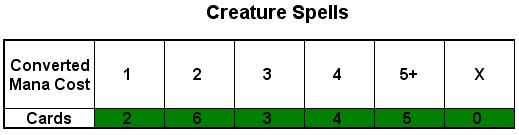
It’s telling that the greatest threat density is found in the 2-drop slot, and even the earliest creatures never quite lose their punch. Most everything Chandra brings to the table has the ability to go large in some way as the mid-game stage is entered.
Take, for instance, the two one-drops (Flamekin Brawler). A 0/2 with Firebreathing, while there’s some congestion with having one out early (do you attack for 2 or play something else on your second turn, since they don’t do any damage without assistance), at no point in the game will they be unwelcome. They might well go down easy with only 2 toughness, but with enough open mana they’ll almost certainly be taking something down with them.
The same goes for the Pyre Charger, one of the deck’s very solid 2-drops, and indeed this slot is loaded with goodies. A pair of Soulbright Flamekin pull double-duty, granting Trample and even acting as a mana accelerant. The lone Fireslinger is a useful pinger despite the drawback, and the last two cards are my personal favourite: the Slith Firewalker. Faced with the prospect of growing out of control, they’re often an early must-answer card in the deck. If nothing else, they are certainly magnets for the Blue mage’s bounce spells.
The 3- and 4-drop spots are a bit narrow, as the deck has given you plenty to do early that will need the extra mana for pumping. Still, there are some useful cards here: a Flamewave Invoker provides a solid dose of uncounterable damage. The Flametongue Kavu begs to be a 2-for-1, and a smattering of Dragons (two Furnace Whelps and a Rakdos Pit Dragon) give you some presence in the air. The Hellbent mechanic on the Pit Dragon is an especially nice touch considering how easy it can be for a Red mage to run out of cards in hand.
Chandra’s deck, however, is lighter on the big finishers than Jace’s. The pair of Oxidda Golems– having Affinity for Mountains- can’t really be considered as 6-drops in fairness, though they are quite inferior to their Jace counterparts as they’re not as robust on the back end and lack evasion. The Ingot Chewer isn’t much of a finisher, but it’s price point reflects its utility as an artifact killer. That leaves the paltry Chartooth Cougar, and the heavyweight Hostility.
Don’t confuse this lack of closers for weakness. Jace’s deck leans on them heavilty to close the gap and get there. Chandra, however, has brought threats at all stages of the curve. For her, the closers are just another set of tools to stitch things up, and you’ll be in little peril if you fail to draw any of them.

Feuer Frei!
Complementing this, of course, is a very robust burn suite- every single noncreature spell (outside of Chandra Nalaar herself, of course) is burn and more burn, and the array of mana costs should easily ensure that you have the flexibility needed to cast them. Here’s the deck’s overall curve to illustrate:

Only have a smidgen of Red mana left over in a turn? A brace of Firebolts and Seals of Fire have you covered. Got a little more to spend? Howabout a pair of Incinerates, a Magma Jet and a Flame Javelin.
Got a bunch, or just want to finish off your opponent? Twin Fireballs, a Cone of Flame, a Demonfire, perhaps followed up by one of Red’s all-time closers- Fireblast– should get you there. Oh, and don’t forget those Firebolts have Flashback and can make a return appearance.
In both Duel Decks, the singleton copy of the relevant Planeswalker ensures that it’s a chance draw that’s a boost when you luck into it, but by no means central to the deck’s win conditions.
It should by now be clear that the deck is a racer, especially against it’s nemesis in Jace. While the mono-Blue offering wants to clog up the middle, stall and delay until its beaters come online, Chandra’s deck has to power through this. As always, you’ll want to save the burn either for creatures in your way, or to finish off a gravely wounded opponent. But there’s more than enough available, even considering attrition from countermagic.
On paper, I actually favour Chandra’s deck slightly, but it will be interesting to see when we put them head-to-head and see how they perform!
Duel Decks- Jace vs Chandra: Jace’s Deck Review (Part 1 of 2)
In 2007, Wizards released what was to be the start of an innovative and highly collectible series of preconstructed decks that featured not one, but two decks designed to be played in opposition. This inaugural deck lifted a page out of lore and pitted the haughty Elves against the reckless Goblins (though their colours are aligned, the tribes need not be). This was enough of a success to prompt a Duel Decks release the following year.
For this one, Wizards tapped into their new and exciting permanent type (as well as intellectual property)- the Planeswalkers- and paired off the power of Red burn versus Blue control. Thus, Jace vs Chandra was born, and it seemed a winning formula, repeated the next year for Garruk vs Liliana, and again later this year with Elspeth vs Tezzeret. (The level of success- and the value of the decks- has been better covered by those with a financial angle on the game, such as here.)
Although the decks themselves are rather scarce (expect to pay about $80 new), are they worth the pickup? It’s hard to argue in favour of that high a pricetag for a pair of preconstructed decks (as you’re well on your way to buying a booster box at that point), but for the collector who enjoys the preconstructeds, is there actual play value here? Let’s find out.
A Little Help From My Friends
The first things you notice about Jace’s half of the package are quite surprising- Jace’s deck is constructed like on a mono-Green model! Not only are over 66% of the nonland cards creatures, but take a gander at this intimidating mana curve:
Green decks can afford to be fat in the back-end because they have ramping options to make the costs more afforable. Blue, alas, has no such luxury.
Furthermore, much like a Green deck, the sparse supply of noncreature spells offers a token support of the deck itself- there’s nothing here that’s gamechanging in and of itself. There’s a smattering of countermagic (two Condescends, two Counterspells, and a Daze); some card draw (Fact or Fiction, Gush, Ancestral Vision); a jot of bounce (two Repulses); and a singleton Mind Stone for the faintest whiff of mana acceleration.
So is this the penultimate incarnation of Big Blue Beatdown? Not quite. Befitting Jace Beleren himself, there’s a great deal more going on here than it might seem on the surface to the casual observer. Indeed, the deck is far more subtle and clever than these initial observations would indicate.
On Second Thought
Of the 23 creatures in the deck, there are but two of them that might be considered ‘vanilla:’ a 4/4 flying Air Elemental, and a Waterspout Djinn (same as the Elemental, but cheaper with a slight drawback). Every other creature brings a little something extra to the table, often emulating the very Sorceries or Instants that inhabit Blue’s segment of the colour pie.
Counters: Both the Voidmage Apprentice and the Martyr of Frost act as additional counterspells. For additional trickery, the Apprentice does so when coming out of Morph (an ability which finds plenty of use throughout the deck). The Willbender has a suprise coming out of Morph as well- acting as a Deflection.
Bounce: A pair of Man-o’-Wars act as early utility, with two other creatures following suit at higher casting costs (the Aethersnipe and Riftwing Cloudskate).
Card Advantage: The Weatherlight-era Ophidian is probably the clunkiest option here, as it must swing and connect to net you a card (in addition to forfeiting damage). The other options are a bit more elegant: two Fathom Seers net you extra cards when un-Morphing, while the Mulldrifter fuses a Bear with Divination giving you utility through flexibility with Evoke.
Utility: A few fewer options here, but there’s a pinger in the form of a Mawcor as well as some additional trickery from the Brine Elemental.
Bombs: In addition to the aforementioned Elemental and Djinn, there’s still another variant of the classic 4/4 flyer in the Errant Ephemeron, whose hardcast cost is seldom the way to go (taking advantage of Suspend is far cheaper, though requires some patience). Guile and the Quicksilver Dragon are also more than capable game-enders on their own.
The rest of the creatures defy such classifications, and range from the useful (the pair of Spire Golems are superb, and truthfully shouldn’t be scored too strongly against the deck’s mana curve) to the frankly underwhelming (a Bottle Gnomes and two Walls of Deceit).
Come Together
So how does the Jace deck integrate? The suite of delaying tactics (countermagic, bounce) combined with the very heavy back-end of the mana curve all but demand that this deck go into the late-game to win. A quick victory here will almost certainly be a consequence of a dreadful draw or mana screw/flood on the part of your opponent, because the tools really aren’t here for an urgent and sustained early aggro strategy.
Instead, the Jace player will want to contain, contain, contain, leaning on the back of the defensive-minded bodies in the deck to clog up the red zone. The extra card draw will then help dig for one of the deck’s aerial closers.
Try and save some counters if you can to protect your closer. Although the top-tier ones (namely Guile and the Quicksilver Dragon) have their own built-in defense machanisms to thwart their demise, many of the other 4-toughness flyers will be vulnerable. They need not be kept alive long- Chandra’s deck is light in the air and has little but burn for defense.
We’ll soon have the chance to see how the deck plays out, but first we’ll be doing something a little different. Typically we’ve kept the deck analysis post and the playtest post back to back, but this time we’ll be taking a slight detour. Before sleeving up Jace for the field of battle, we’ll be popping over to Chandra’s side of things and seeing how it looks. Join us then!
Saviors of Kamigawa: Truth Seekers Review (Part 2 of 2)

In our last update, we deconstructed Truth Seekers and discovered that it was a deck built around a number of comes-into-play intercations with a healthy dose of lifegain to buy time for setting up the pieces. To see how it works in actual practice, I’ve enlisted Sam. It will be something of a ‘mirror match,’ as Sam has selected the G/W Spiritcraft deck (from Betrayers of Kamigawa).
Game One
Game one opens up with Sam winning the roll and dropping a Forest. Pass. I in turn lay down a Plains, and then one-up her with a Ghost-Lit Redeemer, and thus begins a slow but steady stream of creatures that would last much of the game. I play a Silent-Chant Zubera to match her turn 2 Loam Dweller. On turn 3 a slight pause as she comes in with the Dweller.
Not figuring her for any tricks this early, I gang-block with the Zubera and Redeemer, and she flashes a Giant Growth-like Kodama’s Might, sweeping both my valiant defenders to the dustbin of history.
Rebuilding comes right away, though, as turn 3 sees me replace my Ghost-Lit Redeemer and add a Shinen of Life’s Roar. (As an aside, had I known the value of the Redeemers to the deck I would never have put him in harm’s path, but that is part of the unique joy of learning a new deck with an interaction I had not caught).
My Zubera population doubles on turn 4 as another mighty Silent-Chant Zubera enters play. Given the “special bonus” that happens to these things for each Zubera in the graveyard that entered it this turn, I scratch my head and wonder what the point of the card is. Wrath protection? Sacrifice-effects fodder? It certainly seems to have little role in this deck, at any rate.
Nevertheless undaunted, I work the lifegain angle with the Redeemer for two a turn, until turn 6 sees Sam trot out a Kami of the Hunt. Given that most every Instant and Sorcery spell in these decks seem to be subtype Arcane, I vow to keep an eye on him lest he have something of a Kiln Fiend-like effect. My retort to her summons comes in the form of the Briarknit Kami, which will allow me to build up my creature force in much the same way- only permanently. Most everything I play now is making one of my critters even bigger.
I begin putting the pressure on in turn 7 as I play the Torii Watchward, and swing with my beaters. Sam’s now at 15, I’m at 24. Sam has the look of desperation as she coughs out another Loam Dweller on turn 8. Smelling blood in the water, I press my assault, using the Redeemer for an extra attacker rather than lifegain. Although I have Rune-Tail, Kitsune Ascendant in my hand, he won’t be the path to victory today as I slowly grind out a win.
There’s little glory to be had, however, as Sam has gone all 11 turns of the game without drawing a single Plains.
Game Two
The deck really comes alive for Sam in game two. Having solid land drops for four turns, she’s only able to squeeze out a Petalmane Baku but has threats in hand. Meanwhile I’m working on a Ghost-Lit Redeemer and Gnarled Mass. The Mass bites it almost immediately as Sam pumps the Baku with Kodama’s Might. Attacking in I smelled the trap but thought it a fair trade to pull that card out of her hand before she could start Splicing it to better effect.
I replace the Mass with Nikko-Onna, a serviceable 2/2, and Sam drops a Waxmane Baku to start the next turn. My turn 5 play is a Torii Watchward. By the end of the turn, we’re still both at 20 life (I’m actually at 21, thanks to the Redeemer and an early Baku attack).
Things heat up turn 6 as Sam aces the attacking Watchward with a Terashi’s Verdict, a sort of modified White Smother. I replace it with the stalwart Briarknit Kami. Next, Sam adds another Waxmane Baku. The first two Bakus are already happily sprouting ki counters, and another doesn’t bode well. The Petalmane, whose coutners convert to mana, isn’t much of a threat, but the Waxmane’s tap my creatures and can be used to blunt my aggression or even neuter my defense.
The next few turns are a flurry of back-and-forth, with little ground gained. A few creatures die going up over the trenches, but Sam is untouchable and meanwhile, thanks to the Redeemer and a well-timed Dosan’s Oldest Chant, I’ve crested 30 life. Although Sam has discovered the ki counters on those Waxmanes and is tying me up in knots by tapping my beaters, turn 11 sees me play Rune-Tail, Kitsune Ascendant and -snap- just like that, my creatures are indestructible.
Sam’s quit turtling and is pulling out all the stops with an Oyobi, Who Split the Heavens and the resultant 3/3 Spirit tokens it generates. By turn 12, it’s all I can do to cling on as she’s still at 20 and I’m circling the drain at 6. But the Briarknit Kami keeps pumping up my beaters with every casting, and her ki counters on those damnable Waxmanes can only last so long.
Tapping less and less, she’s only able to get me down to 2 (thanks to a game-saving Vital Surge) before I’m able to go all in and finish her off.

Game Three
Sam takes the most aggressive position yet with a first-turn Lantern Kami, a wee 1/1 Flyer, and dropping a second on turn 2. I manage to get out a Moonwing Moth on turn 3 to defend, but she overruns it with Unchecked Growth. By turn 5 it’s already 20-11 in her favour, the Lantern Kami’s promising to make quick work of me if left unanswered.
Fortunately, turn 5 sees me lay down the good-as-gold Briarknit Kami, my MVP of the series, and thanks to a string of unbroken land drops I’m able to turn the tables a bit with a turn 6 Nightsoil Kami. I put the Briarknit’s counter on the Nightsoil, which is now 7/5 fresh from the bucket, and next turn swing back at Sam. Adding the damage to the nick she took from an earlier Nikko-Onna, Sam’s holding at 11 while I’m at 7. After the Kami’s bruising hit, I play the Torii Watchward, a card which has underperformed in the previous two games.
The next round Sam’s still flying in with the Lanterns, with a Kami of the Hunt and a Traproot Kami wall for defense. I catch a bit of a lucky break with the wall- it’s power and toughness are equal to the number of all Forests in play and we’re both playing Green, but between us we’ve only managed four so the wall is a temporary barrier at best.
Marshalling my forces, I Channel a Shonen of Life’s Roar onto Nikko-Onna to pull all blockers to her, which would leave my three beaters (pumped up by Briarknit tokens, as ever) to swing for lethal, but in a clever turn Sam blinks Nikku-Onna with Otherworldly Journey fizzling both my Channel and my plan.
Still, she takes 3 from the attack and is reduced to holding back her Lanterns as chumps. She’s dead a turn later.

Analysis
Truth Seekers was a fun deck to play overall, though I still have lingering doubts about its effectiveness, particularly if facing a fast, aggressive deck. It takes awhile to really build itself up, though once it does it offers a solid amount of flexibility along with some solid bodies to get there with. The lifegain can help in the way that all lifegain helps- it buys you extra time and little more. That said, the flip card Rune-Tail’s Essence effect will certainly punish an opponent who’s given you the luxury of too much time and life. In that regard, the deck works.
There’s a tremendous number of moving parts here when you take into consideration both the creatures’ abilities and the Splice effects. This is both good and bad, depending on the playstyle of the pilot. If you’re partial tointricate, interrelated abilities and effects then this deck will feel quite comfortable to you. If you’d prefer things to be more straightforward (or hate missing triggers or interactions), you may wish to give it a miss.
The block’s core mechanics are well represented here, and playing Truth Seekers will give you a very good idea of what the block’s flavour was. There’s a strong showing for Splice onto Arcane (which I love in part due to its inherent card economy), some Soulshift, a splash of Channel and a flip-card. Add into consideration that the precons in this set are for whatever reason- demand, print run, who knows- exceptionally cheap pickups on eBay, and you’ve got a dependable business-class ticket to visit the land of Kamigawa.
Pros: Solid representation of block mechanics; strong synergy between cards; above-average intricacy and complexity (that may be a con for others)
Cons: Back-heavy mana curve with little ramp support; direct removal almost nonexistent despite the splash of White (may be a characteristic of the block)
FINAL SCORE: 4.1/5.0
Saviors of Kamigawa: Truth Seekers Review (Part 1 of 2)
Although I was not actively playing when Kamaigawa block was released, such was its ripple effect that even now I am aware that many players found the set somewhat less than enjoyable. Comprised of a number of cards that had either heavy interactions with or even outright reliances upon other cards within the block, it seemed very much a self-contained world that did not integrate well with non-block cards.
That aside, a player who enjoys strong story and concept will find a rich, Japanese-myhtos-based world as well as a treasure trove of very interesting and unique mechanics within Kamigawa that make for a fun visit through the block’s many preconstructed decks.

Seeking the Truth
We begin our visit to Kamigawa with a look at Truth Seekers, a Green/White deck from the Saviors of Kamigawa expansion, which concluded the block in June 2004. It is undeniably a creature deck, with only nine non-creature spells on offer. The land count is almost evenly split between the basics, and for added versatility it also throws in a “slow land” in the form of Tranquil Garden.
On first blush, the creatures seem a little top-heavy. Ramping is slight, with only the pair of Elder Pine of Jukai fitting the bill, but the composition of the deck is such that once one hits the table you’ll be taking full advantage (32 of the deck’s 36 nonland cards are either subtype ‘Arcane’ or ‘Spirit’). Still, Truth Seekers packs in eight creatures (and two Sorceries) with a converted mana cost (CMC) or 5 or more. This means that it is a statistical certainty that one of these expesive cards will be sitting in your opening grip, more or less giving yourself an effective mulligan into the midgame.
The rest of the deck’s critters, however, follow a fairly solid mana curve:

Compare this with the curve with the rest of the deck included:
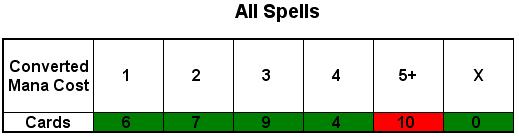
The problem for Truth Seekers isn’t so much in the casting, but in the value for mana. Many of the creatures are slightly overpriced for their power/toughness because they have additional abilities that the deck’s engine relies on.
First the Bad News
For an example of this, consider the following:
Paying 3 for a 2/1 First Strike creature is nobody’s idea of a great deal, and the deck is loaded with such tradeoffs. Only the Gnarled Mass (a vanilla 3/3 for 3), the Ghost-Lit Redeemer, and Dripping-Tongue Zubera come close to cost parity with what you might expect to get out of a creature in the sub-5-CMC range, and the latter one only because it replaces itself.
To compound concern, the nine non-creature spells in this deck concern themselves very little with the fate of your beaters. Sure there’s the Giant Growth variant, Kodama’s Might, but that’s it as far as creature support is concerned. The remainder of the cards concern themselves with lifegain or putting 1/1 Spirit tokens into play.
Examining its pieces in this way, there’s not a lot to be excited about with Truth Seekers. But sometimes you come across a deck that is more than the sum of its pieces, whose interlocking synergy allows the combined deck to punch well above its weight.
And on first blush, this may well be one of them.
A Living Web
The cards of Truth Seekers have a number of interactions that can summarized as follows: exploit creatures with enter-the-battlefield (ETB) effects by returning them to your hand and casting them multiple times.
For this strategy to work, you need to have two resources. First, you need to have creatures with ETB effects (the Elder Pine, Nikko-Onna, Haru-Onna, Briarknit Kami, Bounteous Kirin). Then, you need to have ways to yank them back into your hand (Nikko-Onna, Haru-Onna, Eiganjo Free-Riders). Note the overlap with the Onnas.
As mentioned before, the deck’s creatures at the lower end of the spectrum are somewhat frail, and there’s little in the non-creature range to deal with enemy creatures, so Truth Seekers asks you to put your trust in it to ride out early- and mid-game damage through its lifegain suite of cards. With no effective removal to speak of, it seems a lot to ask.
Put another way: by the time all this casting and yanking back and recasting and splicing and other assorted zaniness is done, you’ll either have a decent-sized fatty to start the beats with (Bounteous Kirin, a pumped Briarknit Kami, Nightsoil Kami, Kami of the Honored Dead), or you’ll be amongst the “honored dead” yourself.

Moving On
Now that we see what the Truth Seekers engine is trying to accomplish, the question becomes whether or not it can succeed. At the very least, this unconventional strategy should make for some interesting games. Join us next time when we put Seekers to the test, and see if it can match ambition with accomplishment.
Contest Winner
The Grand Prize winner of our recent giveaway has decided to share his good fortune with the reading public!
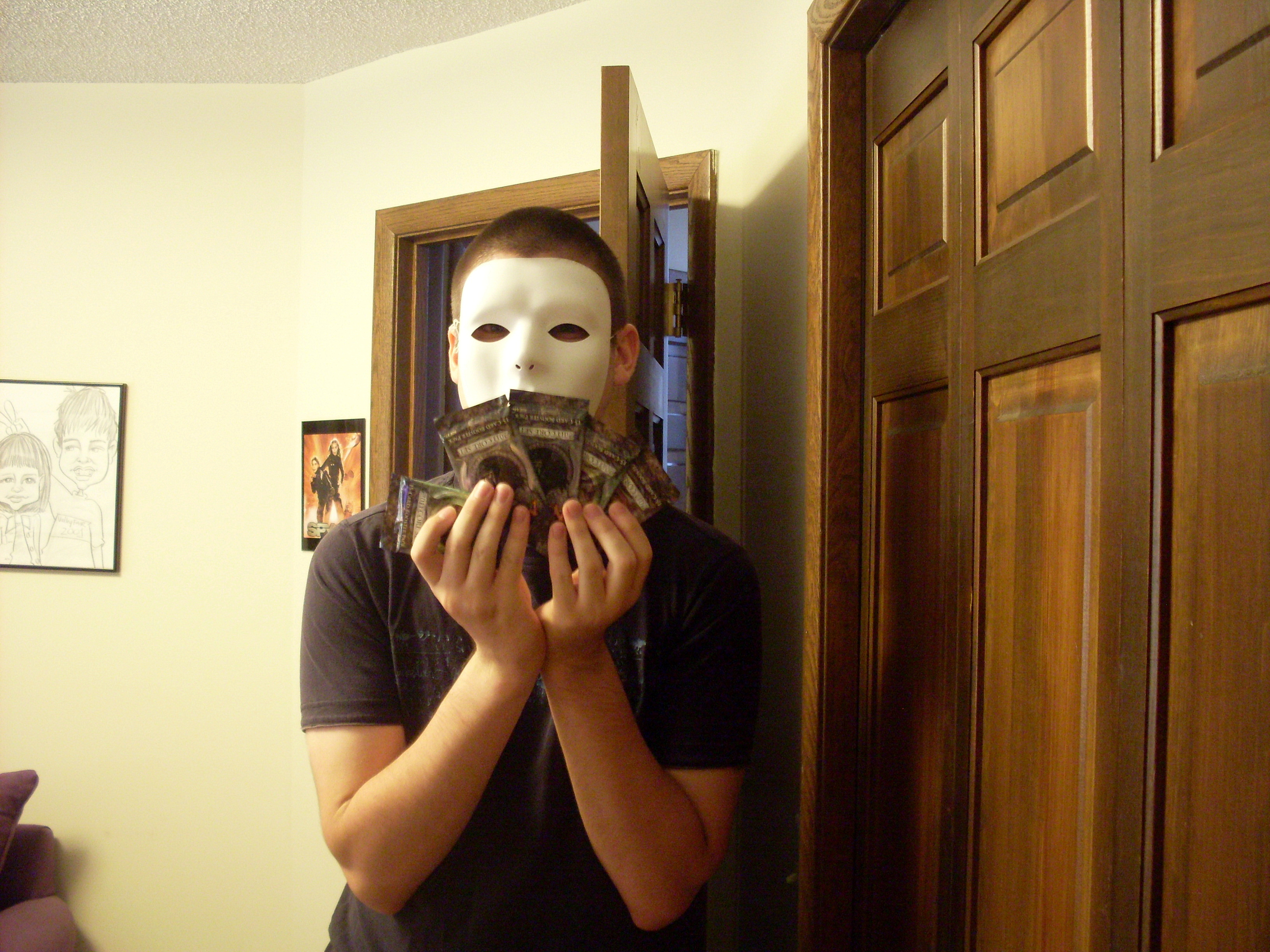
Who is that masked man?
Why, it’s Ben, our most prolific commentator. And what did those five packs of treasure contain?

Three rare lands, a Royal Assassin... and a Time Reversal? Lucky git...
Thanks again to all who entered… we’ll be having another before long.
Magic 2011: Breath of Fire Review (Part 2 of 2)

Welcome back! Having dissected the Breath of Fire M11 precon deck in our last post, today we’ll be putting it through its paces before giving it a final grade.
As you’ll recall, the deck was commended for its overall synergy/interactions and mana curve management mainly with regards to its Red spells, but the Blue component felt a bit like a tack-on. To see how the deck performs, I’ll be taking on Sam who’s putting her faith in the Blades of Victory deck.
Game One
On the play, Sam starts off with a Plains and passes. I drop a Mountain and do the same, knowing there are few turn 1 plays to be had. Sam’s second Plains opens up a White Knight for her, though, and my only answer is an Island. I’m heartened by the pair of Prodigal Pyromancers in my grip, knowing that the Knight’s days are numbered.
Turn 3 sees Sam dropping a land, then dropping my health by two. I deploy the first Pyromancer, and take another two from the Knight next turn. My plan is delightfully interrupted on turn 4, however, when fortune brings me a Cyclops Gladiator. The second Pyromancer is relegated to the back of the bus as I cast the Gladiator instead. Knowing his days are numbered, Sam smartly sends in the Knight again on turn 5. Tapped out from casting the big fella, and unsure of what tricks Sam might have in store, I opt to take the damage and leave her Knight unblocked. By the middle of turn 5, I’m down to 14 while Sam sits 5 higher (my Pinger coming online making the sole mark against her).
My caution is rewarded as Sam shows an Inspired Charge in response to my declaration of attack and invocation of the Gladiator’s special ability. Left unchecked, this would trade the Knight for the Gladiator, but now I have the mana open for a timely Negate and the Knight promptly circles the drain. Sam has no turn 6 play other than a Swamp, and I continue to work her over with the Gladiator and the Pyromancer (saving the ping for the end of her turns). I take advantage of the lull to drop the second Pyromancer, and I can taste victory.
Not going down without a fight, Sam drops the Vengeful Archon on turn seven. Down to 14 life and with Sam on the back-foot I can afford the damage if she attacks, so I play a Fire Servant without fear. She holds back for defense, and when I untap a Chandra’s Outrage (doubled by the Servant) smokes the Archon from the sky. The Gladiator and Servant close in on the doomed Sam.
Game Two
Sam’s off to a stronger start in game two, with an Infantry Veteran and Ajani’s Pridemate on the board by her second turn. I’m stuck with a lowly Goblin Piker, and things only get worse from there.
Turn 3 sees Sam deploy a Palace Guard, and attacking in with the Veteran-pumped Pridemate. The Veteran’s already nicked me for one, and it’s one of the better nuisance cards in her deck. Trying to stabilise I delay casting the Ember Hauler until turn 3 so I could have the mana available to sac him (losing him to a Doom Blade while tapped out from casting him would be painful).
Things grow increasingly grim on turn 4. Sam comes in again with the Pridemate, and I trade out the Ember Hauler in response to her Infantry Veteran. The slain cat worriors are immediately replaced by a Cloud Crusader, and when play passes to me all I have is an Augury Owl. The Owl helped, though, netting me the Cyclops Gladiator and letting me flush a pair of lands to the bottom.
Sam deploys a second Infantry Veteran on turn 5, with the Cloud Crusader keeping the damage on. Down to 12 life, the realisation of the Owl’s destiny as a chump blocker is fast approaching. I do manage the Gladiator on turn 5 before passing, and Sam keeps the pressure on with a timely Armored Ascension on the Palace Guard (giving it +3/+3 as she’s three Plains in play). The airborne duo of the Crusader and Guard swing in, I chump the Guard with the Owl and she pumps the Crusader twice with her Veterans. I’m down to 8, Sam’s still untouched.
Next turn, though, the Gladiator earns his keep, swinging in for 4 and taking out the Crusader. I drop a Chandra’s Spitfire, relieved to have at least one more chump blocker. Turn 7 comes, though, and Sam’s relentless- a Siege Mastodon hits the table. She swings in for another 6 with the pumped Guard, then passes. The end drawing close, I reach over to my library and draw… a Lava Axe.
A widely panned card in the last review, I keenly sense the irony as a flicker goes off above my head and I start running the numbers. Sam’s got the Mastodon to defend, while I have the Gladiator and my turn-2 Piker who’s good fortune has kept him from harm the whole game. I look down at the cards at my hand.
“Lightning Bolt you for three,” I say.
“Okay.” She puts her spindown counter on 13.
“Lava Axe?”
“Okay.” She’s down to 8.
“Aaand then I attack with my 7/3 Spitfire, the Goblin, and the Gladiator.”
Sam’s out of tricks. Me on the brink of death… 16 damage in a turn… Chandra’s Spitfire, I think I love you.

"What am I looking at? Ashes, dead man."
Game Three
Another game, another draw of the Cyclops Gladiator, I haven’t had this much luck since I test-drove Reign of Vampirism and couldn’t shake the Captivating Vampire if I’d tried. Of course, operating on the theory of universal balance, my opening grip also contains the loathsome Goblin Piker, and he’s my turn 2 answer to Sam’s White Knight (admittedly, not much of an answer).
Sam opens up on turn 3, striking with the Knight before dropping down an Elite Vanguard and Ajani’s Pridemate. I answer with a Mountain, and trade off the Piker for the Pridemate the next turn when Sam comes in for 6. She drops down a Warlord’s Axe with a smile, and passes.
At last on turn 4 I have a threat, with the Gladiator touching down for the third time in as many games. Sam plays a Serra Angel. In retrospect I’d later wonder if perhaps I shouldn’t have traded for the Angel, but going in with the Cyclops I murder the Knight instead. The Cyclops does the same to the Vanguard the turn following, but Sam has too many threats. With the Axe on the Angel, I’m dead on turn 6.
Naturally, the Ancient Hellkite sits idly in my hand. One land drop away.

Ready for a condo in Florida
Analysis
Usually between the deck deconstruction and its playtesting, I’ll find a few things that I didn’t think of before, or that I didn’t notice, or perhaps was a little off about. Seldom has the playtesting gone as smooth as this following an examination of the deck- it did exactly what I expected it to, no more, no less.
For one, the Blue component was almost nonexistent: in three games I cast one Augury Owl. Although in fairness I was never locked out of playing any Red card for want of Mountains, it’s certainly conceivable that it will eventually happen. The Blue is out of place here, and the best retuning of this deck would likely strip it out.
As far as rares go, the Cyclops Gladiator is the hidden gem. It’s almost certain to get out in a timely manner in all but the most land-starved situations (though it is the one card most likely to be screwed by the presence of Islands in the deck), and is an absolute beater when it arrives. It can’t be counted on to consistently play the role it did here (three early appearances in three games, and being a dominating factor in two of them), but is one to watch out for (especially in Limited).
The synergy with the Spitfires also helps make this deck very strong. Another note to those wanting to tinker with Breath, cut some Blue deadweight and add two more. Between the Pyromancers and the burn spells, I had little trouble laying in with some noncombat damage, and the card stole our second match for me. Kiln Fiend was a quick hit when Rise of the Eldrazi came out, as many loved how frighteningly big he could become very quickly, but his problem was the lack of evasion (which explains part of the appeal of Distortion Strike). As a flier, the Spitfire has it built right in.
So overall a strongly consistent deck not without flaws, but of all the decks this is the one I would most recommend to any mage looking to use a precon as the foundation for their own deck, and a fun one to play as-is.
Pros: Strong synergy between cards; solid support for the Spitfires; balanced mana curve and spell types; lots o’ burn
Cons: Blue feels completely out of place and adds little to the deck; Goblin Piker has earned a retirement
FINAL GRADE: 4.2/5.0
Magic 2011: Breath of Fire Review (Part 1 of 2)
 Welcome back as we round the bend for the final installment of our Magic 2011 precon deck reviews with Breath of Fire, a Blue/Red aggro deck in support of the devastating Ancient Hellkite. With Scars of Mirrodin some ways off yet, we look forward to delving into Duel Decks, Planechase, precons from other sets, and blasts from the past in the meantime as we head towards October!
An Unnatural Alliance
Magic 2011 has presented us with three decks which pair opposing colours: Blades of Victory (W/B), Reign of Vampirism (B/G), and Breath of Fire. As reviewed here, Blades had a very successful model: use a creature-based strategy as your primary win condition, and use a splash of a second colour in support of the primary. For Blades, this meant an army of White Weenies with some Black removal to get them through.
Reign of Vampirism, however, had a quite different approach, feeling for all the world like a mono-Black deck that had Green thrust upon it. Sadly, Breath- while well constructed- seems to follow in its footsteps.
Let’s begin with the creatures. Breath seems to focus its attention here in three mana cost slots:

Notice that there are no one-drops and very few four-drops to be found, as we’ll be returning to this later. While the overall power level of the early creatures remains rather minor (approximately two-thirds of the deck are weenie-sized critters), Breath augments this with some flexible utility. The Ember Hauler, for instance, is right on the curve: a 2/2 for two mana, but has the added ability to be sacrificed for two damage. Later in the game when he might not be as useful, he’s still a three-mana Shock. Goblin Tunnelers allow for some damage through on a stalemate (and pair well with the two Chandra’s Spitfires, who can grow in power after they’ve been targeted by the Tunneler for some added damage through).
A pair of Prodigal Pyromancers have a versatile role to play as well- not only do they fill the usual role of the pinger (sniping 1/1’s, finishing off wounded enemy critters, extra damage to your opponent), but they too combo well with the Spitfires. Two Fiery Hellhounds round out the three-drops with some extra muscle.
Moving into the more expensive beaters, the Canyon Minotaur suffers dreadfully from comparison with the Cyclops Gladiator, inferior in almost every way, though that’s the tradeoff from being splashable (like the Minotaur) versus quite dedicated (in the case of the Cyclops). From there we find a pair of Berserkers of Blood Ridge (strictly worse cards than the singleton Stone Golem), a Fire Servant and his cousin, Earth Servant, and lastly the premium rare, Ancient Hellkite. This dragon’s an absolute bomb, but his high casting cost (7) means he’ll be an uncommon occurrence in a deck with no ramp options whatsoever.
Much like Reign was build around its Vampires and you wanted to avoid losing them, you should try and protect your Chandra’s Spitfires here. The most synergistic card in the deck, using Goblin Tunneler to make it unblockable, then pinging your opponent with the Pyromancer and sending it though will probably win more games for you than the Hellkite could ever dream of. Add in additional burn (Ember Haulers, Lightning Bolts et al), and the Spitfire can get frighteningly big very quickly. Try and work the deck around that whenever possible for the best chance of success.
Fair and Balanced
The noncreature spells in the deck are an interesting lot. One nice bit of design in Breath is the cost overlap between creatures and noncreatures. Remember above when we mentioned the holes in the deck at the one- and four-drop slots? Two guesses where the greatest concentration of noncreature spells are to be found. Taken together, the deck is fairly well-balanced, if just a little back-heavy:

The noncreature spells themselves are very well-selected for the most part. The most impressive inclusion is a trio of Lightning Bolts. It’s hard to argue that they’re the most efficient burn card in the environment today, and instead of including some inferior options for the sake of ‘variety,’ the developers of the deck acknowledged the absolute necessity of the card in a burn deck by including this many. Kudos! A Preordain and an Unsummon round out the one-drops, all of which are solid selections that will help when drawn at any stage in the game (quite unlike, say, most one-drop creatures).
The two-drop Negate feels out of place in an aggressive deck. Call to Mind, by contrast, can fetch any number of burn spells and therefore is a solid inclusion. Indeed, the latter is probably the Blue card that most feels at home in this deck, rather than just shuffled in for the sake of a two-colour deck. Some solid burn (three Chandra’s Outrages, a Fireball and two Lava Axes), an Aura (Shiv’s Embrace) and a Foresee round out the deck. I don’t ordinarily care for Lava Axe (an extra Bolt and Outrage would have been preferable), and I care less for it here, where both the Bolt and Outrage would have the same synergy with the Spitfires but give a great deal more flexibility. Considering an extra Lightning Bolt, how much better are two points of damage really, when you are paying four mana more to cast them at Sorcery speed? The only saving grace is if you’re able to get it off while the Fire Servant is out- “catch!” indeed.

Feeling the Blues
Breath of Fire– like many precons- does suffer some from suboptimal card choices (most notably the Berserkers of Blood Ridge, the Lava Axes, the Minotaur and even the lowly Goblin Piker), but in such times it is important to remember that Wizards is working within certain constraints and that these decks are not designed to be ultracompetitive. On the face of it, for instance, Stone Golem is a comparable to the Berserkers when comparing power/toughness and cost. The Berserkers, however, have the drawback of requiring an attack each turn, even when that attack might be unprofitable. That the Stone Golem is vulnerable to artifact kill is a minor consideration (one Naturalize and one Solemn Offering in the other four precons)- it’s mainly because the Golem is Uncommon. With only 12 Uncommons per deck, a balance does have to be struck.
The greatest sin of Breath, then, is that it feels forced. As mentioned above, there’s only one Blue card in the deck that has any synergy with the Red spells, and that’s Call to Mind. Everything else is simple utility and Scry options. Don’t get me wrong, Scry is fantastic, but it’s hard to escape the nagging feeling that the deck could be even faster and more lethal with Blue stripped out of it. As it stands, it feels just a bit too slow and cumbersome to fill the traditional role of the Red deck: strike fast and burn hard.
So the questions remain: Does the utility of the Blue more than compensate for the weakness of splashing it? Is the deck focused enough to do the job? And are the pair of Spitfires enough, or does the deck have a strong win condition on the ground? Join us next time when we take Breath of Fire onto the battlefield, to see how it measures up.


 Ertai's Lament
