Duel Decks- Elspeth vs Tezzeret: Elspeth’s Deck Review (Part 2 of 2)

Keen to get the decks out into the field after a thorough breakdown of each, I challenged Sam to the customary best-of-three. She took Tezzeret leaving me with Elspeth, and here are the notes from the matchups.

Duel Decks- Elspeth vs Tezzeret: Tezzeret’s Deck Review (Part 1 of 2)

The role of the Artificer has long held a rightful place in the world of Magic: the Gathering, truly beginning in 1994 when a small, 100-card set was released three months after Arabian Nights. Called Antiquities, it introduced a flood of artfacts into the game, and lent itself well to those seeking to take on the role of a mad tinkerer.
Flash forward to today, and one need not go back all that far to find the role alive and well. Archenemy’s Assemble the Doomsday Machine cast its villain in such a role, as did Planechase’s Metallic Dreams. Alara block’s Esper decks tread a similar path. But in looking over the contents of the Tezzeret deck, this may well be the very best of the lot.
That’s not necessarily the same thing as saying that it plays better than any such deck previously released. What we mean is this: if you’re looking for a deck that gives you the feeling of actually playing as an Artificer, a mage surrounded by mechanical minions- this one is the best in breed.
To see why, let’s begin with a survey of the workshop.
Duel Decks- Elspeth vs Tezzeret: Elspeth’s Deck Review (Part 1 of 2)

Just in time to tease us with new contect for the forthcoming Scars of Mirrodin set, Wizards has released a new Duel Deck. This time, it features two mainstays from Alara Block, Elspeth, Knight-Errant and Tezzeret the Seeker. Certainly if for no other reason, this Duel Deck has been the subject of considerable hype due to its printing of a high-dollar card (Elspeth): a package ostensibly less- pricewise- than the sum of its parts.
With such decks, however, one has to ask what value they are getting for their money. Certainly the term ‘value’ comes in many flavours, but we’ll be looking to answer the specific, fundamental question of: how does the deck play? Over the next four columns we’ll be examining the latest Duel Deck in the Ertai’s Lament manner: a piece on the deck’s construction followed by “in the field” testing. We’ll begin today with Elspeth’s mono-White deck.
Duel Decks: Elspeth vs Tezzeret Spoiled
For those who don’t want to wait until 03 September to pore over the contents of the latest Duel Deck, they have been spoiled today! You can read about Elspeth’s deck and Tezzeret’s deck to get your fix.
Ertai’s Lament will have full reviews once they’re released!
Planechase: Zombie Empire Review (Part 2 of 2)

Much like this year’s Archenemy, last year’s Planechase had a deck devoted to Zombies and the Undead. As previously reviewed, Bring About the Undead Apocalypse was a delightfully intricate concoction, particarly when weighed against its predecessor, Zombie Empire. It had fatties, recursion, and loads of ways to cheat the beats into your graveyard for reanimation.
Zombie Empire, by contrast, distinguishes itself with a more Tribally-based theme. There is recursion, but it’s less for cheating the deck’s bruisers into play and more for asset recovery. The deck is single-minded in purpose, and has more or less one win condition:

The trick, then, is to do this well, and to give you all the tools you need to accomplish it. How does Zombie Empire fare? Let’s begin by looking at the fundamental building block of the deck: its Zombies.
Wizards Announces New Preconstructed Product
Wizards today announced the forthcoming “Event Decks,” which will be “strong, capable Standard-legal decks” designed for the more competitive player who wants to make the transition from the kitchen table to their local Friday Night Magic. Here’s the official announcement, and a link to some of the forum discussions here. Although nothing but speculation at this point, there’s some interesting concern and debate over the possible contents of the decks.
Here’s a reprint of my comments on the forum regarding the use and positioning of these forthcoming Event Decks:
As a passionate collector and reviewer of preconstructed decks, I’d be very surprised if these supplanted the “intro decks,” because both have a different place in the market. A common assumption about precons is that they’re in some way meant to be “good,” assuming that the definition of “good” means “competitive against non-precons.” Some are, some aren’t, but obviously you’re not going to have consistent success against a T1 deck with one.
Personally, I see precons as drawing upon the best elements of both Constructed and Limited, and work best when seen as a “fly in amber” representation of what the designers and developers were trying to do with a particular set. Taken in that vein, they’re quite a bit of fun to play when you can “revisit” sets from years ago and try out new cards and mechanics you might not have been around for.
Much like Wizards makes cards that are deliberately poor as “skill testers,” precons have existed in the same design space with some of their choices. This may make them unpalatable to some, who are looking for a competitive experience right out of the box, but it certainly helps those newer to the game. There’s a certain, necessary realisation that has to occur to progress in skill, such as when you look at, say, a Runeclaw Bear and realise- aha!- a Garruk’s Companion might be a better choice in the slot. It’s easy to forget after long years of play how incremental learning the game often was for many of us. The alternative is to simply netdeck a list and run with it rather than develop your own fundamentals.
Most precons will step up their power quite noticeably if given some careful pruning- weeding out the suboptimal, and adopting a four-of mentality to increase consistency. Again, this is a teaching tool- my first decks forever ago were sprawling, 120-card singleton affairs, and it took awhile to learn such lessons.
From the sound of it, these Event Decks won’t be world-beaters, but probably second-shelf consistent performers that are sort of “Precons 2.0”- the learning-curve cards and goofy elements that showcase a set’s mechanics will be gone, repalced by consistency with an eye towards perfoemance: 4-of Lightning Bolts, Spreading Seas, or what have you, wrapped around a theme that’s a little tighter than most.
So long as they don’t replace the existing precon structure I’ll be excited as heck for em! They may not cause me to leave my beloved Grixis Control or RDW decks at home each week, but they’ll be a fun alternative.
More preconstructed decks to dig through and review? Ertai’s Lament says, “yes please!”
Planechase: Zombie Empire Review (Part 1 of 2)

It’s been awhile since we reviewed a deck in the format of playtest-then-analyse, but if ever there was a good candidate for a revisit of that model, it’s Zombie Empire on a nice, tranquil Friday night (this was written on 8/20). Having played the deck before, it holds few surprises but still can be a lot of fun to play, and to give it a foil Sam picked up Elemental Thunder in her comfortable colours of Green and Red.

Game One
On the play, Sam kicks things off with a Shivan Oasis before passing, and I as expected drop a Swamp. The first play of the game goes to Sam’s Fertile Ground, which she casts upon her Oasis for a nice little shot of ramping. I repeat my turn 1 play.
Things kick off in the third, as Sam gets out a Rockslide Elemental, a 1/1 for now but with the promise of getting bigger. I make an investment in my future, passing up playing a creature for Phyrexian Arena. Although I’ll take damage for it every round (and I’ve died to it before), getting the card advantage out this early massively skews the game in my favour.
Planechase: Metallic Dreams Review (Part 2 of 2)

To give Metallic Dreams a good run for its money and to see how the deck functions under pressure, Sam and I decided to put it through its paces against Zombie Empire, a nasty mono-Black Planechase deck. Much like Phyrexia vs The Coalition, it would be interesting to see how an essentially five-colour deck handled itself against a single-coloured one. Here are our game notes…
Planechase: Metallic Dreams Review (Part 1 of 2)
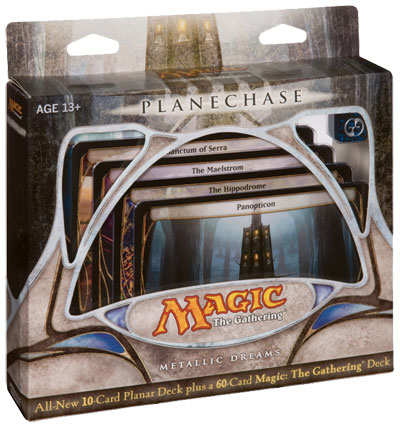
Centuries before the first tides of the Quicksilver Sea rose to meet each new sun, Mirrodin’s light shone on the golems alone…
While not directly tied to Mirrodin thematically, it would be impossible not to acknowledge the heavy imprint of that set and story upon the Metallic Dreams Planechase deck- a design which rests very heavily on the golems and their affiliated kin. Metallic Dreams is an uncommon thing- a deck which shies away from allegiance to and playstyle of any particular set of colours, instead choosing to both embrace and shun the coloured path on its way to victory. That may seem impossibly contradictory, but once you dig into the deck it begins to make perfect sense.
We’ll start our analysis of this most unconventional deck in a conventional manner, by focusing first upon its creatures and the role they play. As with Archenemy, Ertai’s Lament is less worried about the Planechase mechanic (planes, die, and all), but rather how the actual preconstructed deck itself plays out. The Planechase design proper can be lots of fun and has been covered extensively elsewhere- we’ll be looking at the deck.
Duel Decks- Phyrexia vs The Coalition: The Coalition deck review (Part 2 of 2)

Eager to put The Coalition through its paces to see how well it performs, Sam and I broke out the Duel Decks and faced off for the customary three matches. Would the speed of Phyrexia run roughshod over the more intricate setup of The Coalition, or would I be able to bide time enough to bring my more powerful Domain and creature cards on-line? Here are the notes from the matches.


 Ertai's Lament