

Magic 2011: Stampede of Beasts Review (Part 2 of 2)

Welcome back to part 2 of our Stampede of Beasts deck review. As seen in our previous entry, Stampede is aptly-named, designed to crank out massive beaters and dominate the red zone, while offering a splash of Red to keep things clear on the ground. It should come as a surprise to precisely no-one that Stampede packs in the most creatures than any other M11 precon, 10% more in fact than the runners-up. Green is the colour that typically gets what it needs done through the beasties, and you’ll find no exception here.
Besides hefty creatures, the other thing Green is commonly associated with is Ramp: the ability to add additional mana sources early to get to a higher level of resource early, and thus put the board in a state of asymmetry. In short, Green likes to play its endgame in the midgame. A look at the mana curve for the deck’s critters should give a clue as to why this is so critical:
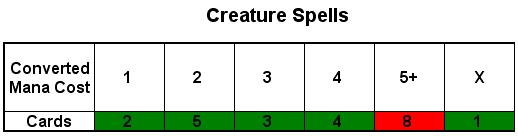
As revealing as that is, it doesn’t actually tell the full tale itself. Let’s break out the 5+ category a little more:
5-drops: 4
6-drops: 2
7-drops: 2

From humble beginnings...
Um, I Was Told There’d Be No Math
To illustrate how critical ramp is, let’s take a moment to understand what it means to be a 7-drop. Let’s assume you plunk down a Duskdale Wurm into a generic Green deck that has no ramping ability. You have the customary 40% land in a 60-card deck (24 land cards). On the play, you draw your opening hand: it has three lands and generally looks playable, so you keep it. Ta-daa! You’re all but guaranteed to make a land drop on each of your first three turns:
Turn 1: Land
Turn 2: Land
Turn 3: Land
What about those draws? Since you’re on the play, no card for you on turn 1, but you drew for turns 2 and 3. Since your deck is 40% land, you’ve got a 40% chance to draw one each draw, so in two draws it’s 80% likely that you picked up another land.
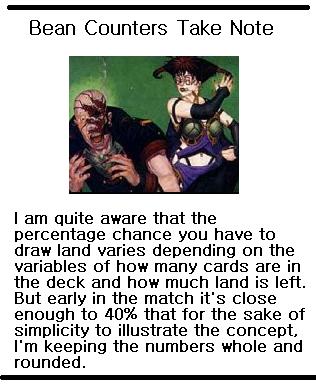
Let’s put this another way: you’re unlikely to get a land in one draw; likely to get a land in two draws, and (statistically) certain to get one every three draws. That means by the time turn 4 rolls around, you’re in good shape, but let’s go from there assuming a land drop every three turns.
Turn 4: Land
Turn 5: No land
Turn 6: No Land
Turn 7: Land
Turn 8: No land
Turn 9: No land
See a pattern? If it plays out just like this, you’ll be dropping that seventh land- and ready to launch that Duskdale Wurm into action- on turn 13.
That’s a long time to wait. Most games are already over by then, which means your Wurm was uncastable. And that means you basically mulliganed for free at the start of the game, since you only had six playable cards where your opponent had seven. Not a place you want to be. Now every Magic player knows that you can get a glut (or shortage) of land, and again for simplicity’s sake we made the numbers rounded and easy, so your actual mileage will vary game to game. But seven land drops is a lot to expect without any kind of acceleration.
Quick & Dirty: Here’s a rough and quick rule of thumb to know when you’ll be able to cast something without ramp. Take it’s converted mana cost, subtract three (since you’re assuming you’ll be hitting at least your first three drops), and for each point of CMC left over, it’ll take approximately 2.5 turns after turn three to deploy.
Example: Baneslayer Angel cosys 3WW, total of 5. You should hit your first three drops, so that leaves you needing two more drops (5 – 3 = 2). You can expect to cast your Angel 5 turns later (2 x 2.5 = 5). Actual mileage will vary depending on draw and deck, of course, but it’s a handy rule of thumb.
So Ramp 101 behind us, with the worrying amount of fatties that can clog your hand in Stampede of Beasts, what sort of help is included? The short answer: probably not as much as you’d like. With pairs of Llanowar Elves and Sylvan Rangers, and a singleton Cultivate, that gives us 5 ramp options in the deck (almost 60% of the time, you can expect to have one of these options in your opening hand). By way of comparison, you’re statistically certain (>100%) to have a card that costs 5 or more, which puts you at an early disadvantage.

The Race is On
Okay, the maths section is behind us, promise. It’s good to understand just how a deck is designed to work and why, but for those who just don’t care for numbers (and there are many), the short version is this: Stampede of Beasts has a ton of expensive creatures and is a bit light on ramping into playing them. Since you can’t twiddle your thumbs and wait for all that land to arrive on its own, you have to keep your opponent busy in the meantime.
Luckily, Stampede has a variety of ways to do this. There’s a splash of burn in the form of a Fireball, a Lightning Bolt and a Chandra’s Temper Tantrum– one of each, mind, so make them count. Extra bonus points if you manage to string together Act of Treason and Fling, stealing an opponent’s beastie, attacking with it, then using it for one last bit of kindness. The Plummet will eilinate a flier, the two Giant Growths pull their customarily varied duty here (add damage, kill a blocker/attacker, or avoid burn). Back to Nature, being Instant, can often be cast to your advantage in combat, and is good utility at any time. There’s a burn finisher included in the form of Lava Axe, and additional critter utility with a Whispersilk Cloak.
The crowning gem, though, is the foil premium: Overwhelming Stampede. Decried by some as a less-potent replacement for the unreprinted Overrun, it’s an easy spell to sell short but can be an absolute beating when used properly (comparable to Might of the Masses vs Giant Growth in that regard). Rather than a flat +3/+3, Overwhelming Stampede gives a bonus equal to the power of your strongest creature. This can be brutal (if you’ve got that Duskdale Wurm out, all your attackers basically get Might of Oaks + Trample), but carries some risk. If you’ve got a 7/7 ready to lead a charge of 2/2’s and 1/1’s, and your opponent responds to this spell by Doom Blading your fattie, when Overwhelming Stampede resolves you’re looking at a much-less-desirable +2/+2.
By the same token, though, get that Wurm out and Giant Growth it before casting this, and your opponent will be praying for a Fog or it’s lights out.

Back to the Forest
All that is well and good, but there’s hardly enough there to make a dent on its own without some creatures thickening up the middle. Looking again at the beasts of the wood, we see a decent (if somewhat ordinary) selection of critters in the deck.
In addition to your Sylvan Rangers, two Runeclaw Bears round out the two-drop slot. Boring and eminently disposable, things do pick up somewhat from there. A pair of Awakener Druids let you trade risk of losing land for threat and damage, and are best played no earlier than turn 4 (so that the Forest you choose to animate isn’t summoning sick or tapped). A lone Sacred Wolf is a a novelty with it’s ‘troll shroud’ (partial Shroud named after this guy), but a 3/1 is too fragile to last long and probably is best used to trade with a comparable beater on your opponent’s side of the table.
The 4-drop slots are split between Giant Spiders and Prized Unicorns. I’ve seldom cared for the Unicorns, finding their ability conditional and too weak for their cost, but the Giant Spiders are prizes here. In a deck that wouldn’t mind a little time to get its mana together, the Spider offers a very solid body and answer to smaller fliers. Next, though, is when things get truly interesting.
Once you’re at your 5th land drop, the deck has a tendency to speed up. With half your creatures having (or attainable in the case of the de-mythic’ed Protean Hydra) 3 power or more, you should have little difficulty drawing into some bonus cards courtesy of the two Garruk’s Packleaders in the deck. Do what you can to maximize this ability- like holding out on casting that Wolf- and you’ll thank yourself later. Extra draws are indispensable for not only digging through your library for answers, but also for getting those critical land drops!
Of course, if you’ve managed to get to the endgame (preferably during midgame), Stampede of Beasts makes it well worth your while! The vanilla Spined Wurm is just a hint of what else is in store: trampling brutes like the Duskdale and Yavimaya Wurm, a Greater Basilisk, and of course that Protean Hydra. There’s not much that will manage to stand for long against these, and the upside to having multiple copies is that you can lose the occasional pet to a Doom Blade or Condemn and still have plenty of gas in the tank.

Final Thoughts
For those that revel in throwing about massive creatures and smashing face with them, Stampede of Beasts is the deck for you. There are plenty of options to keep you busy in the early and midgame, and the deck does hold its own against the other M11 preconstructeds. If it’s your cup of tea, it’s worth considering.
Pros: Decent assortment of noncreature spells give some flexibility; massive beaters end the game very quickly when unleashed; deck has coherent strategy and focus
Cons: Huge spike in the mana curve at the back-end means you essentially start the game with 6 cards; mana ramp suite a little underwhelming; Prized Unicorn and Runeclaw Bears stale and overused; would take a Lightning Bolt over a Lava Axe most any day
FINAL GRADE: 3.75/5.0
Ertai’s Lament Spotlighted on The Mana Pool!
Well, okay, ‘spotlighted’ is a bit of a stretch, but we’re delighted at the mention in the latest podacast from The Mana Pool. As it turns out, lontime listener (and frequent reader here) Ben sent in an email recommending the site to the Mana Pool guys, and it sparked some discussion:
Mike: It’s called Ertai’s Lament… and the dude takes the precons that Wizards makes- they’re Intro Packs now- and he tests them out to see how they work and he analyzes how they’re put together and Ben thinks it’s pretty cool, so it might possibly be… pretty cool… so go there and find out whether it’s… pretty cool.
Brian: Yeah, we cannot guarantee or completely deny any coolness it may or may not have. And personally while I have not had the time to check it out, I’ve been busy with something- I’ll spare you the details- I do like that premise.
Check out the episode, which includes a long review section on notable M11 cards that’s quite enjoyable!
Thanks for the mention, fellas, and we hope you’ve found some time to stop on by and check the site out. And thanks to Ben for the good publicity!
Magic 2011: Stampede of Beasts Review (Part 1 of 2)
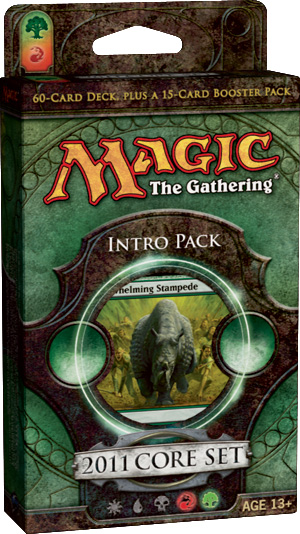
Emerging from Vampire Weekend, we’re back and ready to take on the second-to-last of the M11 preconstructeds, Stampede of Beasts. This Red/Green Burn & Beats deck looks impressive, and intriguingly sports the only premium foil rare that is not a creature.
To see how it faces against real competition, I challenged Jimi to the customary three games, and she selected the Red/Blue Breath of Fire deck. A push on the burn aspects, would my Green stompers or her Blue manipulation be the deciding factor?
Game One
On the draw, I’m off to a roaring start with a turn 1 Llanowar Elves, follwed by a Sylvan Ranger (fetching a Forest) and Awakener Druid, swinging in for 4 with my animated land.
Jimi’s start is a little less steady. She manages an early Goblin Tunneler, then Preordains into a turn 4 Chandra’s Spitfire. It looks like I have her on the back-foot, though, and I eye the options in my hand. The most attractive one is the foil, Overwhelming Stampede. If she’s not able to increase her creature count, a quick strike could be devastating. But I also have a few creatures I wouldn’t mind getting out to participate, a Protean Hydra foremost amongst them. The longer I wait, laying out my beasties, the deadlier the strike, but the greater her chance to blunt the attack.
The Hydra comes down turn 4, and I opt on turn 5 to go for a freshly-drawn Garruk’s Packleader, all the better as Jimi dismisses the Hydra with a Chandra’s Outrage at end-of-turn. By turn 6 I decide it’s time and cast the Stampede, ready to swing in for lethal (her Chandra’s Spitfire has been coming in on the attack, and thus can’t block those last few points of damage).
Jimi, however, has other ideas. A pair of Lightning Bolts in response take out the Elves and the Druid, leaving the now 8/8 Packleader charging in alone. The attack is blunted, but it still cuts her in half down to 8 life. I’m at 17.
As is often the case in a splendid game of Magic, the tides turn and now Jimi’s the one with the momentum. She keeps coming in with the Spitfire, and summons a Fire Servant and Cyclops Gladiator to assist. I manage a solid defensive play, a Greater Basilisk, which should dissuade her from any funny ideas with that Cyclops. The extra card from the Packleader is gravy.
Undeterred, Jimi swings with the Cyclops, invoking its “arena” type ability to trade it for the card-drawing Packleader. A timely Giant Growth in response keeps my Packleader safe as her very surprised Gladiator makes his way to the bench. In a moralebreaker of a moment, Jimi consoles herself by casting Ancient Hellkite… which immediately draws a Plummet.
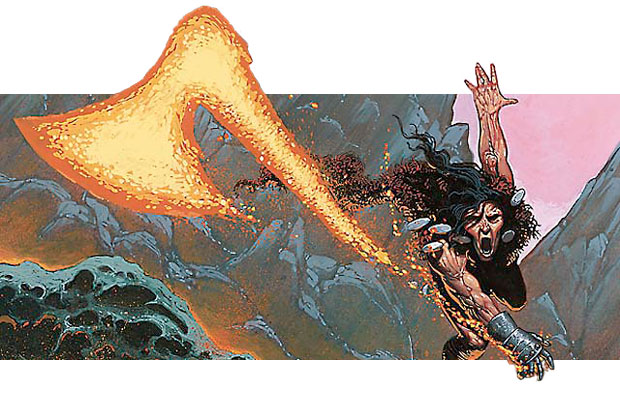
I send the Basilisk alone into the red zone the turn after, and Jimi shows she’s not quite ready to get rid of her newly-cast Berserkers of Blood Ridge just yet by letting it through. The Goblin doesn’t get “volunteered” either because it’s the only thing getting her Spitfire past a Giant Spider I’ve managed to drop. It’s all the opening I need, though, as I tap 5 and show Lava Axe.
Game Two
In a game with very few missed land drops, Jimi gets out early with another Goblin Tunneler, while I redeploy an early Sylvan Ranger. I’ve got a loaded hand with a couple expensive Wurms, so the land fetch is even more critical than the Elf. She attacks with the Goblin on turn 2, and I take the trade.
Turn 3 sees Jimi lay out a Prodigal Pyromancer, the first of a consistent stream of bad news to come. Looking at the fatties in my hand, knowing that the first crop of land drops are much easier than the last few, I make a calculated gamble, casting Nature’s Spiral to bring back the Ranger. She’ll die again to the pinger, but fetch me another crucial Forest.
It plays out exactly as anticipated, but meanwhile Jimi’s brought an Ember Hauler online, and follows it up with a turn 5 Fire Servant. Trouble. My gamble pays off, though, when I am able to squeeze out a Spined Wurm in response. It seems like too little too late when the Servant is granted Shiv’s Embrace the next turn, and swings in for 6. I answer with an attack of my own for 5, then drop a second Sylvan Ranger for the land, desperate to offload one of the other two Wurms now lolling about in hand.
A timely Back to Nature strips off the Embrace, and I’m brought down to ten. I have no answers in my hand and little to work with on the board, so I try a desperate ploy with an Act of Treason knowing my Wurm can hold off the Servant (but not answer it). I opt to take her Ember Hauler, hoping she’d overlook it’s sac ability and could then use it to snipe her pinger. She’s wise, though, and offs it in response, throwing the two damage my way. It’s not quite the waste it appears, because with my life total dwindling and defenses nearly nonexistent, it’s been a profitable attacker.
Alas, her Foresee comes up with an answer, and her six-point Fireball (doubled to twelve due to the Servant) ends any hope of a rally.
Game Three
A quick aside.
Back in 2002, Wizards held an invitational face-off game of Magic that would tie in with a promotional product. Each contestant had to build their deck on a predefined set of criteria (including how many of each rarity, and which sets were legal to draw from), then would play a best-of-three to see who would come out ahead. On the one hand you had Richard Garfield, the creator of Magic. On the other was Jon Finkel, still widely regarded as the best player to ever play the game.
Much hype and ado was made of this clash, including the Deckmasters: Garfield vs Finkel boxed set (a nice historical pickup if you can find one at a reasonable cost), and while Finkel was given a slight edge as favourite, all expected a rollicking back-and-forth contest between two Magic luminaries.
The result was anything but.
Finkel took the first game in part to Garfield making two timing errors (causing him to joke, “Shouldn’t we be playing by the rules as I made them?”). The second ended the match with a whimper rather than a bang… Garfield was mana-screwed the entire match, and Finkel’s Balduvian Horde smashed face, and again, and again, and… Game over. For those who appreciate irony it was perhaps the best possible outcome, but in general it seemed very anticlimactic (not least Finkel, who said that for the first time he was “honestly unhappy” that his opponent met such an end).
But this is Magic, and such things are a built-in, unavoidable part of the game. While Jimi and I are hardly a Finkel or Garfield, that’s how our third game ends as well. I run out an early Llanowar Elves, followed by a Giant Spider a turn 4 Awakener Druid, and begin my attack. Jimi’s first play of the game is a turn 4 Foresee. A Fiery Hellhound and Lightning Bolt (on the Druid) are the happy outcome, but a Duskdale Wurm lands and begins going to work. Eventually she has to chump her Hellhound and the subsequent Berserkers of Blood Ridge, and the Wurm relentlessly gets there.
Fizzle, not bang.
But again, such games are a not unimportant part of Magic, and while less glamourous than a full-on contest (with its own box set commemorative release), still yield valuable information. Had I been playing a slow control deck, Jimi might have had the added time she needed to draw into some win conditions. As it stands, the explosive power of Stampede of Beasts saw her off in short order.
We hope you’ve enjoyed reading this playthrough of Stampede of Beasts as much as we enjoyed experiencing it. Beasts is a fun deck, though prone to some awkward situations and worthy of further examination. Join us next time when we tear the deck down to its fundamental building blocks and see what it was designed to do, and how consistently it can do it.
Magic 2011: Reign of Vampirism Review (Part 2 of 2)
In our last review, we took Reign of Vampirism out for a spin, and it performed admirably in no small part to the strength of drawing the premium foil, Captivating Vampire, early and often. Of course, being a singleton it’s hard to rely on such fortune, but it’s useful to break down the rest of the deck and see what results can be expected with consistency. As we’ll see, the deck is solid in that particular regard, but has some gaping flaws in its design.
As discussed in yesterday’s opinion piece, Vampires have been retooled and reconfigured for Magic starting with M10 and Zendikar. No longer the occasional bomby rare, they have shoved past Zombies and claimed the mantle of Black’s tribal champions. That said, they occupy a similar place on the ‘food chain,’ of sorts, now recast as fast, aggressively costed and typically smallish creatures designed for an aggro rush, and Reign of Vampirism showcases this to good effect.
Party of Five
To take advantage of Captivating Vampire’s steal-a-beater ability, five Vampires need to be in play, and Reign nudges the odds in its favour with a wide array of them: 65% of the creatures selected are Vampires. Revealingly, if you exclude 4-drops and above, the percentage spikes to just over 81%. Fine math, but what does it mean? Let’s take a look at the curve chart:
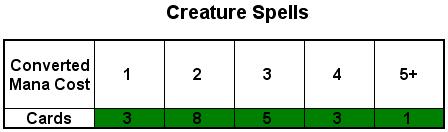
Reign leads off with a trio of Viscera Seers, one-drop Vampires whose ability- requiring the sacrifice of a creature- should almost exclusively be used in conjunction with the pair of Reassembling Skeletons. But it’s at the two- and three-drop slots that the bulk of the creature swarm is located.
Consistency is unusually valued in this deck: witness the three copies each of Bloodthrone Vampire (another synergy with the Skeletons), Child of Night, and Barony Vampire. These aren’t the ultra-aggressive Vampires of Zendikar (think Vampire Lacerator), but they’re fast if fragile and should be able to get you out ahead early.
The last two early creatures are more utility-based. In addition to the aforementioned Captivating Vampire, there’s also a Royal Assassin who’s as much a deterrent as anything. There are not a lot of big beaters in the deck, and it works best with an early Swarm strategy. The Captivating Vampire’s requirement, though, means that you’ll be handling Weenie creatures with greater than usual care. Trades are typically not to your benefit, and you may need to let your life total run down a bit avoiding losing your precious Vampires to blocking.
Assisting you in that regard are the few reasonable beaters the deck offers: two Howling Banshees, a Giant Spider and a Spined Wurm. The Giant Spider- typically somewhat of a defensive choice- isn’t necessarily out of place here, as a four-toughness blocker can thicken up the red zone, buying you precious time to find the Captivating Vampire and bring four additional Vampires online.
Once you do, the game should be ending very quickly in your favour.

Towards That End…
Unusually for Black, Reign’s suite of noncreature spells is a bit light on the removal, but for the most part does seem to have been selected with some care. Almost everything is in support of your Vampire-centric strategy, and should be used accordingly. The lone Giant Growth, for instance, makes the customarily fine combat trick (and ersatz removal), but often can serve a nobler purpose of keeping your Captivating Vampire safe from Lightning Bolts, Last Kisses, and anything else that threatens his ability to make a living. Should he succumb, a Nature’s Spiral and two Rise from the Graves ensure that the cause is not lost. And should drawing into him elude you, a pair of Diabolic Tutors give you ways to find him.
As for the removal suite, use them with care- there aren’t many. Two Doom Blades are the only instant-speed kill the deck boasts, while a pair of Quag Sicknesses and Corrupts round out the package. Corrupt is a welcome addition due to its ability to serve double-duty as direct damage to your opponent, though its effectiveness is somewhat hampered by the fact that Reign is a two-coloured deck. Corrupt is a very greedy spell which works best in mono-Black.
Quag Sickness, too, suffers from the same limitation, though it occupies a curious design space. Given the nature of the spell, it may well linger for a time on an opponent’s beater until you’re able to reach enough Swamps to make it lethal. On the upside, it gets around the limitation of Doom Blade, as it doesn’t care about the colour of its target. On the downside, it’s less effective against Green, White, and Blue (the first two because of enchantment removal, the latter because of bounce). Naturalize and Cultivate offer a splash of customary Green utility.
The deck’s lone artifact, Sorcerer’s Strongbox, is dreadful but can be a rationalised by the fact that Weenie decks tend to blow through their cards early, so even a run of bad luck with the Strongbox isn’t as painful as it might be for other decks. It is, however, still dreadful.
When taken together, the deck’s curve fills out a little bit more:

Analysis
Because of the high amount of card repetition relative to other preconstructed decks, Reign of Vampirism should offer a reasonably consistent playing experience. Dump a swarm of Weenies out early for some quick damage, retrench and use selective removal to stagnate the board, all the while looking to get out four Vampires and the Captivating one, either through direct draw or by tutoring. Steal creatures, and bring the game to an end.
This is Reign’s most effective win condition, but backups exist in the form of the larger creatures and the Corrupts. If things are going pear-shaped, hope to draw some removal and kill something you can then animate. It should go without saying, though, that the deck’s odds are considerably diminshed if the Camptivating Vampire long eludes you.
If there is a grievance I have with the deck, it is with the colour selection. Reign really wants to be mono-Black, and there’s very little Green offers it here: two whole creatures, a trio of lesser utility cards and a nifty combat trick neatly summarise Green’s contribution, while at the same time it throttles out the growth potential of Black’s removal suite like a weed in a garden. Whenever Wizards releases a preconstructed deck utilising opposing colours, I always sit up and take notice, because such combinations can lead to fun and unusual combinations. In this deck, it feels like a forced tack-on to avoid making a mono deck (not an unreasonable desire, given that both Zendikar and Worldwake had mono-Black offerings), which is probably what it was. Compare this to the Ears of the Elves deck, which was the inverse (Green splashed with Black) and by contrast felt very well integrated both thematically and mechanically.
Pros: Consistent play though use of multiples; solid synergy (multiple sac effects with Reassembling Skeleton, strong Vampires presence for Captivating Vamp’s special ability); mana curve ensures ease of deployment; stealing things is fun
Cons: Removal cards underperform in multi-coloured environment; Green feels “tacked on”; Captivating Vampire’s ability forces possible overcommit of forces which can be vulnerable to sweepers; removal a bit weak; Sorcerer’s Strongbox
FINAL GRADE: 3.5/5.0
Opinion: On the Evolution of the Vampiric Species
I wouldn’t have thought I’d have felt this way, but let me go ahead and get it out there as we begin: I’m perhaps starting to get just a liiiitle worn out of Vampires in Magic preconstructed. Black Weenie/Swarm is a fine strategy, but it seems like just a bit much on the flavour as we crack into the third Vampire-themed intro deck in less than a year.
For the longest time, Vampires had a checkered history in Magic. With rare exception, the early ones borrowed more heavily from Count Orlok than Lestat. Observe, then, a brief origin of the species, and some thoughts on the future.
Early Vampires
Early Vampires were all but devoid of the ‘sexiness’ we now associate with them. Indeed the first-ever Vampire, Sengir, seemed to set an early tone by lapping at some veins and arteries (though in a twist two years later, would have a momentary redemption).

Vampires: 1993 - 1998
Two years after the release of the game, Vampires would defy their early conceptualisation and stand at a crossroads, as Homelands introduced us to the Sengir clan. Possessing the same predatory will as their predecessor in the card pool, Homelands chose to infuse its vampiric antagonists with a healthy dose of aristocratic bearing more in line with the romantic notion of the vampire found in popular culture.

The Sengirs
Although the cards themselves reveal only Legends, Oracle shows them properly errata’d to be a Vampire, Vampire Dwarf, and Human Wizard, respectively. Despite her suspect appearance, in the lore ‘Grandmother’ Sengir is a Bathorian mortal who sustains her unnatural lifespan through the fluids and essences of young women. Bon appetit!
But the veneer of sophistication was not meant to last, and Homelands as a set was a general disappointment. Whether or not the critical reception of the set had anything to do with it, Wizards would put Vampires firmly on a track that stripped them of an urbane and sinister aspect, and instead emphasized their predatory (and sinister) image, as seen above. By the time Tempest rolled around in 1997, it was even possible to have the vampire degenerate into a form no longer even identifiable as human. And the horizon didn’t offer so much as a shred of hope…
Midrange Vampires
It would take quite awhile for things to come full circle, and indeed, judging from some of the cards released vampires hit a very deep and bestial low.

Vampires of the early- to mid-2000's
Yikes! From the gangly Treacherous Vampire to the more alien Mephidross one, it seemed a race to the bottom to see which one could be more bestial and hideous than the next.
Adding insult to injury, Vampires at the same time were widely marginalised, typically assigned as Rare cards with some flavourful powers but given no tribal support. A search today of Gatherer yields only 55 cards with a subtype Vampire, and bear in mind a large chunk of those were from only very recent sets. But why the relegation to the fringes? Why so little love for the bloodsucker?
Turns out, Wizards had crowned another to carry the Black tribal banner, which left the vamps with little attention or focus to go around:

They're coming to get you, Barbara!
Zombies! From very humble beginnings indeed, Zombies quickly became Magic’s Black tribe of choice, with over four times as many cards with subtype Zombie in it as Vampires, which doesn’t even begin to include other cards for Zombie support, be it Enchantment (Zombie Infestation), Instant (Cruel Revival) or even non-Zombie creature (M11’s Grave Titan).
At some point, Wizards had weighed their options, and put the Vampires on the back bench. It would take a stirring in popular culture, along with a back-to-basics approach from Wizards to generate the seismic shift needed to vault the vampires into the spotlight.
The Modern Vampire
A few years ago, as Zendikar design was reaching a close and Magic 2010 was getting underway, fortunes began to change for the Vampire deep in the bowels of WotC. The romantic ideal of vampirism which has periodically flourished only to die down again (see: 1994’s Interview with a Vampire, 1987’s The Lost Boys, etc… pop culture is a study in recycling) surged back to unlife in the form of Edward Cullen, True Blood, etc.
Twilight certainly cannot get sole credit, but it splashed vampires back into the collective consciousness and again paired them with a certain sensuality and aesthetic. Although the story of how Vampires overthrew Zombies and Demons and asserted themselves as the tribe for Black is a long one and well worth reading, the short version is this:
1. Vampires are popular
2. Zombies didn’t quite convey the full feel of what Wizards wanted out of Black’s iconic tribe
3. M10’s “back to basics” approach meant that nothing was sacred, and habit and tradition could be swept aside
All of this lead inexoribly to the redemption of the Vampire in modern Magic. While the hunger remains, the beastliness has been replaced with that same sense of sensuality:
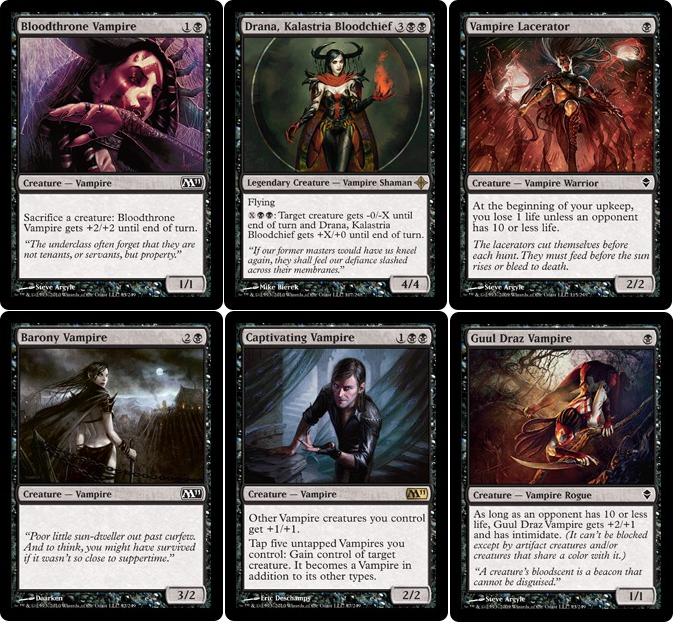
Vampires 2009+
Far from their ghastly origins, the modern Magic Vampire has become a far more attractive lot- they have truly evolved. (And is it just me, or is Drana, Kalastria Bloodchief a- pardon the pun- dead ringer for Brittany Murphy?)
Cradle to the…
So what can we expect from Vampires in the future of Magic?
First, I wouldn’t expect them to fade away anytime soon. Having a strong Core Set (M10, M11) presence means that in one form or another they’ll be sticking around for awhile. And while all of 2003-04’s Mirrodin Block contained exactly one Vampire, he was a flavour doozy (turning all of your other creatures into Vampires). We won’t know until this Autumn how great a role Vampires will play in Scars of Mirrodin, but it’s a safe bet they’ll be there. Thematically, Vampires had a strong role in Zendikar block, but set after set we don’t really connect Golbins or Elves with any particular set or story arc. They’re just always… there. You can expect the same from Vampires.
That said, there’s still a ‘novelty factor’ with the tribe, as evidenced by their overt presence in recent theme decks, as mentioned at the start of the article. Look for that to die down as well once the tribe becomes “normalised.” After all, it’s not too often you find a tribal-ish theme deck featuring Goblins (Scourge’s Goblin Mob and Lorwyn’s Boggart Feast notwithstanding).
It does look, though, that the Vampire is here to stay… even when Edward Cullen and his ilk fade into temporary obscurity.
Magic 2011: Reign of Vampirism Review (Part 1 of 2)
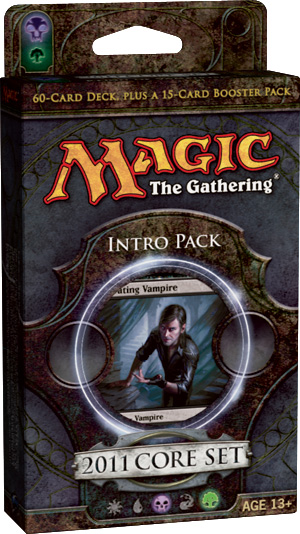
Just when you thought it was safe to tap out after dark, Magic 2011 brings us yet another Vampire-themed preconstructed deck in the Black/Green Reign of Vampirism.
Both Zendikar-block Vampires decks (Rise of the Vampires and Fangs of the Bloodchief) relied on fast, Black Weenie-style tactics with low casting-cost critters to overwhelm the opponent before they established board position, with a couple aces for the endgame to break through a stalemate (such as Anowon, the Butcher, Zombie Goliath, and Blood Tribute).
Vampires in the Zendikar world were a carefully-crafted tribe with a deep backstory and vital role to play in the world’s lore. By nature the Core Sets are devoid of such placement, and exist more or less on their own. To see how M11’s Vampires fared, I suited up for battle against Sam, who was piloting Power of Prophesy, the set’s U/W theme pack.
Game One
With turns one and two passing with nothing but land to show for it, I’m growing worried that I’m off to a slow start. This favours Sam, whose deck needs a little time and space to get going, but is an omen of doom for mine. Sam’s on the play and her turn 2 drop is a Blinding Mage. I have no answer.
The Mage attacks on turn three and draws first blood, but I’m able to hit that third land drop that enables me to play a Barony Vampire. She’ll be able to tap it down for attacking, but it’s a start. Sam returns with a Visions-reprint Cloud Elemental.
The Elemental can only stand by uselessly as I drop my foil premium rare, Captivating Vampire. The +1/+1 is greedily welcomed by my attacking Barony Vampire, and just like that I’m ahead, 16-19.
Now entering turn 5, Sam draws, attacks with the Elemental, and passes. I keep the pressure on with a Viscera Seer and Child of Night. Although her next turn play is solid- the foil Conundrum Sphinx, I draw into a Bloodthrone Vampire and just like that I’ve got five Vampires on the board for the Captivating Vampire’s special ability. The Conundrum Sphinx is ‘persuaded’ to join the winning team, and Sam’s prospects for victory are rapidly diminishing.
A turn 7 Sleep buys her a little more time. My play is the detested Sorcerer’s Strongbox, which I can’t activate this turn having only 5 mana available. Sam stalls again with a Wall of Frost, which I also relieve her of. A Quag Sickness takes care of the pesky Blinding Mage, and Sam’s fate is soon sealed.

Game Two
An early start this game sees me with a Viscera Seer and Bloodthrone Vampire in the first two turns, while Sam looks to gain card quality advantage through a Crystal Ball played on turn 3. My take is a risk- a solid start, but I have expensive cards in hand (Diabolic Tutor, Corrupt), and the Captivating Vampire I again find myself with is stuck for lack of one more mana. With the Crystal Ball filtering her draws, I know I don’t have the luxury of time.
I’m further set back on turn 4, when Sam’s Aether Adept bounces the Bloodthrone Vampire to my hand. My Vampires have done a little damage to Sam, but I can barely afford the regroup. I recast the Bloodthrone and hope for the best.
Sam keeps her momentum going with an Augury Owl, the new Sage Owl variant, but I hit a bit of luck and draw a Forest. The Captivating Vapire comes down, and my newly-pumped minions rush in for 4. Sam’s now at 13 life, I’m in good shape with 18.
A Water Servant complicates matters when Sam casts it on turn 6. With the ability to pump in either direction (to a point), it can easily hold off my smaller Vampires though the threat of an attrition I cannot afford. I enchant it with Quag Sickness, and with two Swamps in play it’s now a 1/2- much more manageable. Not to be outdone, Sam drops a fresh Water Servant the next turn, and I’m back where I started. Still, I drop a Barony Vampire, my fourth on the table.
Turn 8 arrives, and Sam draws into a Solemn Offering. Just like that, my Quag Sickness is undone, and her next attack sees me to 11 life. Again, though, I break her back when my 5th Vampire is played- a turn 8 Barony Vampire, and in quick succession I steal my way through to win, with a final Giant Growth seeing the job done.
Game Three
“I wouldn’t worry,” I say to Sam as we begind drawing our opening hands, “I doubt I’ll even see the Captivating Vampire this time, I’m already ahead of the odds getting him off twice.”
And for three turns, I’m actually right. I draw him on my fourth turn, having already played the game’s only critter thus far, another Viscera Seer. Sam’s turn 3 play is a Wall of Frost, and things start to look like a repeat as I cast a Barony Vampire and the Captivating Vampire the turn following. Looking at the arsenal in my hand, I suspect Sam’s in for a quick loss.
She’s surprised when turn 5 brings me a Spined Wurm (a reprint from my much-beloved Tempest), and when I Doom Blade her Wall and storm in the next turn for 13, she’s in real trouble.
But Sam’s had some time to finagle with her deck, casting an Augury Owl, Foresee, and Jace’s Ingenuity to filter and refresh her hand. The turn 7 Sleep is a lifesaver, which she follows up with a Scroll Thief. She Sleeps me again on turn 8, netting a free card from the attacking Thief (alongside the Owl, who’s now pecked me twice). All I can do is lay down a Socerer’s Strongbox, but I catch a break and crack it on the first try.
But the damage has been done. Sam’s stalling has robbed me of the overwhelming momentum I had in the midgame, being one attack away from certain victory. And now she’s put some defenders in place: Maritime Guard, Water Servant, and a Cloud Elemental now stare back across at me. While Sam’s at 6 life, she’s well-entrenched, and my best recourse now is either to wear her down with waves of attacks, or find another way to her. When I draw a Diabolic Tutor on turn 9, I know it’s now my chance. I cast it, and go fishing.
Turn 10 sees more stalling from Sam as she plays another Foresee and drops a Blinding Mage down. I surprise her with a Howling Banshee. The 3/3 body is welcome but not all that helpful; her enters-the-battlefield ability, however, is. Now clinging to three life, Sam throws out an Air Servant, but has no answer when I untap and cast the Corrupt that I tutored for, for four damage. Just like that, it’s a sweep.
A Little Bit of Luck
I certainly was the beneficiary of good fortune in these three games, I don’t want to give the idea that the Power of Prophesy is a cakewalk, but having the Captivating Vampire out for each of the three games (while she drew into her Sphinx just the once, and promptly had it stolen) lends to a one-sided appearance. Still, as we’ll see in the next post, the deck is indeed designed to get the Captivating fellow out early, and is built around him. Join me in just two days as we break the deck apart and see for ourselves!
Magic 2011: Power of Prophecy Review (Part 2 of 2)
Welcome back! When last we left, the Blue/White M11 preconstructed deck was showing that, indeed, there really was some power behind its prophecy, and in this session we’ll be taking a look at exactly how it’s accomplishing that.
Generally speaking, when one thinks of “Blue/White,” it brings to mind slow, control-based strategies. As with the Tapout model in Standard at present that’s not always the case, and Power of Prophecy takes the latter approach- mainly through filling the skies with a swarm of evasive beaters. Indeed, it follows to the letter the seeming M11 precon formula, which has surprisingly little deviation over the five decks:
Two colours
20 creatures
15 noncreature spells
16 primary colour land
9 support colour land
Naturally, there is a lot of room for individuality within each deck, and its relative strength or weakness is contingent upon how well the cards selected fill the role they’ve been slotted for. Let’s begin with the beaters.
Aim High
One of the strengths of the deck is its consistency- it boasts one of the most stable mana curves of any yet reviewed:

What does this mean? Mainly, that you shouldn’t experience creatures bottlenecking in your hand all that often, provided you have a reasonable amount of land plays throughout the game. More than once I’ve been pleasantly surprised at how smooth a ride the deck can be.
That being said, not every card is a winner, but they’ve all a role to play, and most seem to be adequate for the task. Utility critters take up the 2-drop spot, featuring a pair of Augury Owls for deck manipulation, a Blinding Mage, and a pair of Maritime Guards. The Guards aren’t proper utility at first blush, but you can be sure that the main job of an early 1/3 critter is to buy you time and blunt any early rush the enemy puts up.
There’s more utility where that came from at the 3-drop spot: a pair of bouncers in the form of Aether Adepts gain some tempo in the early game, and can be useful throughout. A Wall of Frost is another speedbump, and the Scroll Thief is there for card advantage. But here we also begin to see our beaters: a pair of Cloud Elementals herald what’s to come.
Conundrum Sphinx– the foil premium rare- is in good company at the four-drop spot. While the offensive power of the Azure Drake is a bit underwhelming, his toughness does recommend him as either an attacking option or able defender. Add in a pair of versatile Water Servants, capable of turning into a 6/1 when some muscle is needed, and up to a 0/7 on defense, and you have reasonable answers to most combat situations.
One key thing to look for in a card is versatility- it’s why the Charm spells are so popular, and why I rate even spells like Stabbing Pain higher than they might first appear. The more things you can do with a particular card, the more valuable that card becomes. Being versatile doesn’t make a card great on its own- if it lets you choose from three different crap effects, it’s still a crap card. But it does make a card more valuable in its position, and Water Servant easily fits this bill.
As for the Sphinx, in Power of Prophecy it’s probably best to look at him as what he’ll be most of the time: an ultra-efficient beater. With few Scry options in the deck (two Owls, two Foresees, and a singleton Crystal Ball), chances are you’ll be naming “Island” every time it attacks, and occasionally getting lucky- just as your opponent will after they catch on.
Also offering some versatility is Water Servant’s equally indentured cousin, Air Servant. On its own it’s a 4/3 flyer for five mana, which isn’t dreadful, but it also packs a very keen dose of utility in its semi-Twiddle ability. Note too that it does not require the Servant to tap and thus can be used multiple times in a turn, and should the skies clog up you still have a way to get through for damage.
Armored Cancrix is nothing sexy, but is included in the deck to act as a wall with teeth. Not a very good card, I have not yet had an opportunity to be delighted when I drew it. The last two critters, though, are anything but mundane.
As a singleton 6-drop, the Harbor Serpent will be coming out neither early nor often, but you shouldn’t find its limitation to be too much of an impediment by the time you’re looking to play it. The deck’s other rare- a Stormtide Leviathan– is a must-deal-with card for your opponent. Not only is it an ultra-efficient beater (8/8 for 8 is right on the all-singing, all-dancing curve), but it also boasts none of the drawbacks that usually torpedo big Blue beaters (remember this guy?).
As with all the decks, noncreature spells take a solid backseat to the critters, acting more as secondary support. Although not the most glorious lineup of cards, Power of Prohpecy’s beaters acquit themselves quite well when taken as a unit, with a solid curve and good versatility. How do the other spells stand up?
Get Thee Behind Me
Sadly, with a few breakout exceptions, overall the complement is underwhelming. The removal suite is almost nonexistent- one copy each of Condemn and Pacifism means that your creatures will be doing most of the talking for you. It offers a couple of mediocre combat tricks (Mighty Leap and Safe Passage, though the former has a dose of added versatility with the evasiveness it temporarily grants). Two Negates and a Solemn Offering offer some utility, and a Mind Control can be a very swingy two-for-one.
The aforementioned Foresees and a pair of Jace’s Ingenuity, while not inexpensive, give you some much-needed library manipulation and card drawing, and can be the difference in close games (as an aside, for an outstanding article on the mothership about the design and synergy of the Planeswalker’s spells, see this one). But the consistent all-star of the deck for me was Sleep, and the deck offers two.
At four mana, you’ll want to be holding onto one of these for a special occasion, but it can be a gamewinner if timed correctly. Optimally, you’ll want to cast it when the sum of all the power of all your creatures, except your largest one (unless it’s evasive), equals half the life total of your opponent. In other words, assume they’ll be able to cast a chump blocker on their next turn and at least have something to defend with. Cast in this way, you should be able to get in for lethal the turn after you play it.
Of course, games seldom run as planned, and it also makes a fine play to give yourself some breathing room to establish board position for a turn (at 4 mana, you probably won’t be casting too much else that turn).
Final Thoughts
I’m not all that excited about the noncreature spell complement with Power of Prohpecy, but as many times as I’ve played it it usually does just fine with its well-balanced creature lineup. When assessing the board and planning your tactics, you can’t count on drawing into removal, so plan accordingly. That aside, the beaters are for the most part fun and effective, and even if you can’t optimise Conundrum Sphinx, the guessing game can still be good for a laugh (in one game my opponent- on the verge of dying the following turn- flipped over the Fireball that would have given him the game). Like Blades of Victory, the deck is a noteable improvement over last year’s offerings, and well worth picking up.
FINAL GRADE: 4.5/5.0
Magic 2011: Power of Prophecy Review (Part 1 of 2)

As I recall it, my first ever Magic deck (going waaaay back, here) was a Blue/White hundred-card monstrosity, and from the beginning, though I’ve strayed away from the Combination (White in particular), I’ve had a soft spot for that flavour of deck.
The Blue/White offering for Magic 2011 is Power of Prophecy, and although we typically equate Control (or more recently, Tapout) with this spectrum of deck, Wizards tends to construct a precon that finds its sweet spot somewhere in the middle. In the past year we’re seen Worldwake’s Flyover, which used a lot of flyers in conjunction with Archon of Redemption for skies aggression and lifegain. Also in the mold was Rise’s Leveller’s Glory, which went for a more balanced White Weenie approach with some Blue support.
To see how Power of Prophecy ranked amongst its predecessors, I took it to battle against Jimi, who lined up behind the Rise of Vampirism deck.
Game One
On the play, Jimi opens her first three turns with a good mix of land, a Child of Night, and a Barony Vampire, looking to establish an aggressive board position. I take advantage of a turn 2 Augury Owl to Scry my deck, which dies blocking the Child of Night on turn 3, but does set up my next play of a Cloud Elemental.
My claim to the skies is strengthened with a turn 4 Azure Drake, temporarily neutralising the threat her 3/2 Vampire is posing (though it’s already bloodied me once).
Jimi appears to hit a bit of an impasse on the next turn, and she casts Diabolic Tutor to look for an answer. I swing in with the Drake/Elemental tag team, and pass. Unsurprisingly, the Captivating Vampire she Tutored hits the table next round, and just like that my Drake defender is outclassed.
I’ve got a Harbor Serpent in my hand, and could use the beefy body on the board, but by now I’d expect any Black/x deck to have some removal. Instead, I cast an Armored Cancrix, gambling that she will look to remove the roadblock and return to profitable aggression.
It works. I give silent thanks to the lobster taking a Doom Blade for the team, and drop the Serpent on turn 7. Our attacks have kept pace, though, as we’re tied at 8 life apiece. With the Drake and Elemental tapped from whittling down her life, I’m gambling now that she won’t attack unprofitably, but that’s what she does on turn 8, sending the Capitvating and Barony Vampires in. Killing one I’m down to 6 life, and Jimi ends the game with a 6-point Corrupt.
Her timing is perfect, I’d drawn a Sleep and was intending to use it to close the game out the next turn.
Game Two
This game starts as before, with some land dropping out and me laying down a timely, turn 2 Augury Owl. I’ve long been a believer in the Sage Owl, and this one certainly qualifies as “new and improved.” No more stuffing crap to your bottom draws and having to eat through it in a couple turns; Scry lets you flush the bad draws to the bottom of your library.
Jimi’s turn 2 response is a Viscera Seer. The Owl goes into the red zone on turn 3, then I play a Scroll Thief, while Jimi changes the board with a Captivating Vampire. Turn 4 is a wash- the Azure Drake I lay out is welcome, but neutralised by her answering Giant Spider. My Cloud Elemental on turn 5 is matched by her Barony Vampire, and she Naturalizes my turn 6 Crystal Ball. Fun!
Still, I’m able to engage the Ball once on the way out, and it nets me a gem: Sleep. I cast it next turn and go all in, taking her from 17 to 11, then again the next turn down to 5. A bit underrated, Sleep can be a serious closer if you’ve even a moderate board position to work with. I add an Air Servant to my arsenal on turn 8, and Jimi’s lone Giant Spider isn’t enough to keep my flyers from coming in for victory.
Game Three
I begin the final match advancing some merfolk: the Maritime Guard on turn 2, followed by the Scroll Thief. Jimi lands a Barony Vampire, but surprises on turn 4 with an unexpected (and unwelcome) Howling Banshee. We both lose 3 life (and I’ve already taken 3 from her Vampire), but more importantly she’s got a presence in the air she hasn’t had the past two matches. My turn 4 response is an Azure Drake, which does nothing but add to a stalemate.
I can only chuckle with sympathy as Jimi plays one of M11’s truly heartbreaking cards, Sorcerer’s Strongbox. I’ve won the flip on the first go many times with the card, but never when I truly needed it. I break the impasse, however, with an Air Servant, whose tapping ability will clear the Banshee out.
The next turn, Jimi once again lucks into playing the Captivating Vampire. My own foil premium, the Conundrum Sphinx, is in my grip, and while I’d enjoy taking him for a spin, I see a stronger victory condition in hand. Sleep once more breaks the red zone wide open, and my beaters flood in for full advantage. Jimi’s at 15 life, and I’m attacking with 8-power of creatures. Without any change to her board position she’s finished the next turn, and throws her lot in with the Sorcerer’s Strongbox.
She loses the flip. Then the game.
Thoughts
There was a lot to like in the performance of Power of Prophecy. While the Sphinx/Scry gimmick is a nice bonus, with a singleton Sphinx you’ll seldom take full advantage (hint: absent Scry, name your highest-used land). But then, it scarcely needed it. The beaters seem to be on a solid mana curve, as I didn’t have any problem getting them out as needed and at pace. And Scry may well turn out to be a momentarily underrated mechanic. When previewing the set, I thought it nice but not game-changing. My opinion has swung upwards, and with cards like the Crystal Ball and the Owl upgrade, chatter is already coming in from the Prereleases that Scry punches above its weight.
Can one expect comparable results from Power on a consistent basis, though? Join me next time as we deconstruct the deck and explore every card. Thanks as always for reading!
Magic 2011: Blades of Victory Review (Part 2 of 2)

Welcome back to our kickoff review of the Magic 2011 Intro Packs! For those unaware, Wizards heeded the outcry from the community and has reinstated the 60-card deck Intro Pack, complete with booster, rather than the somewhat short-lived 41-card model. This means, of course, that you will be seeing your premium foil rare a bit less often (as well as any other singletons), but that by adding duplicate cards the overall consistency of the deck should remain about the same (for example, the Breath of Fire deck packs in three Lightning Bolts… chances are, you can rely upon drawing at least one in a game).
To start us off, we took a look at Blades of Victory, a White Weenie deck with a twist of Black thrown in for removal. Despite a few misgivings in card selection, it had a solid look about it, and to test it out I went up against the Sam-piloted Stampede of Beasts deck. How did it do?
Game One
On the play, I make my first mistake of the game not shipping my hand, instead keeping one with perhaps one Land too many to start off with. Sam gets out early with a turn 2 Sylvan Ranger, which replaces itself in her hand with a land. My turn 3 Palace Guard looms large to hold back this colossal 1/1 threat, and even the Sacred Wolf she answers with is no match for the mighty 1/4.
Although seemingly mana-flooded (I would not miss a land drop for the entire 10-turn game), I am able to get a potent body out on turn 5 with a Serra Angel. While Sam used turn 4 to Cultivate, on 5 she drops a Llanowar Elves and Prized Unicorn. The Elves are mana ramp- nothing I can really do about that- but the Unicorn troubles me. With the dismal situation with my hand after all these land draws, I know I need to protect what little I manage to get out. The Angel’s demise is but a Giant Growth away, as she can do nothing to avoid blocking that Unicorn, so on turn 6 I swallow hard and Pacify it. The Angel draws first blood for 4, and we’re off.
Sam’s turn 6 gets a little more robust- another Llanowar Elves, paired this time with a Garruk’s Packleader. Next turn I Mind Rot her (she throws away a Runeclaw Bear and, somewhat concerningly, a Giant Spider), leaving two cards in hand. One of them is a Protean Hydra, which she elects to play as a 7/7. I sense danger starting to mount.
I attack with the Angel a third time on turn 8 (Sam’s now down to 8), but Sam topdecks a Chandra’s Outrage and burns it out of the sky. She swings in with the Hydra and Packleader, and I chump with the Palace Guard, taking some Trample damage in the process.
I draw my card on turn 9, sigh, and pass the turn. Siezing the opportunity, Sam drops Overwhelming Stampede and comes in for the alpha strike.
A quick aside on the hideousness of that card. Although for simplicity’s sake I write that we ‘roll’ to see who gets to choose to play or draw first, we actually already have it predetermined before the first game. When starting a playtest session, we play a warm-up game (we call it a ‘friendly’) which doesn’t get recorded (and for which we do, in fact, roll). Loser then gets the luxury of choice for the first of three ‘official’ games.
In our friendly game prior to this one, Sam had a Duskdale Wurm in play, along with a few other gadabouts and hangers-on. Although it looked like I might be able to pull the game off, Sam sealed the deal by Giant Growthing her 7/7 Wurm, then casting the Stampede. As my ragtag army looked downfield and saw 90-power’s worth of beating enter the red zone (all of her creatures gained +10/+10 and Trample), I can only imagine they soiled themselves as the cause was lost between a thunderous trampling of hooves and claws. The card is a monster, be warned.
This time, I cackle in triumph- I had just drawn a Safe Passage, and narrowly avoid a second hideous beating. But it’s a token victory, for having no answer to her next strike I can only concede.
Game Two
The next match immediately looks more promising, as I open with an Infantry Veteran then drop another Palace Guard on turn 3. Sam plays a turn 2 Runeclaw Bear, and we begin trading attacks (using the Veteran to pump up the Guard means that Sam cannot profitably trade, and she realises this). Turn 4 sees Sam with another Prized Unicorn, and a Spined Wurm on the turn following.
I have answers in my hand, though, in the form of a Doom Blade and a Pacifism. In a move that would come to haunt me, I drop the slower of the two on the Wurm to neutralise it, saving the Blade for later. We’re still whittling each other down, but when her Unicorn and Bear are joined by a Giant Spider on turn 6, I call and end to ground operations and play a timely turn 7 Serra Angel.
Sam’s response is devastating. She casts Fling, and opts to sacrifice the Pacified Wurm, smoking the Angel. The Doom Blade in my hand is small consolation (and indeed, is shortly burned to kill her thrun 8 Yavimaya Wurm). It was a backbreaking play, and having passed midgame and into endgame with no appreciable threat, Sam’s able to get there with a couple profitable attacks and closes with a perfectly-timed Lava Axe.
Game Three
Third time looks to be the charm, as I ship my first hand having learned the lessons of the first two games (although now as bad as the first game, I certainly drew into more land than I would have liked in the second). My gambit is rewarded with a delicious grip, including the deck’s actual “combo” of Ajani’s Pridemate and Mantra. What luck!
The Pridemate comes down on the second turn, followed by the Mantra. Sam, seeing the link, breaks it with Back to Nature before I’m able to gain any life, but I’m still carrying a ton of momentum. While Sam still hasn’t played a critter by turn 4, I drop down a White Knight and the War Priest of Thune. By now I’ve figured out that Sam’s deck has little to no enchantments in it, so no need to hang on to the Priest as I have before.
Things seem to be going my way, and moreso on turn turn 5 when I come in with the Knight, the Priest, and the Soldier (sounds like a joke, eh?). Her freshly-summoned Giant Spider opts to block my first-striker, a fatal mistake when I respond with Mighty Leap. Sam’s down to 12 life.
Sam replaces the Giant Spider on her next turn, and I cast Stabbing Pain to take it out of commission. It’s early to say, but I have a good feeling about that card- it’s a surprising amount of versatility packed into a 1-drop (pinger/pest kill spell, combat trick, and blocker removal, all in one). The Spider can only watch as my three amigos rush by to cut Sam in half to 6. I then drop a Warlord’s Axe and pass turn.
Sam casts Act of Treason on the Pridemate to get in for token damage (I’m down to 18), but she’s running out of tricks. I equip the Axe to my Knight, go all in, and that’s the end of the Spider. Sam’s down to 2. A last-ditch Awakener Druid gives Sam two blockers, but at 2 life she’d need one more to survive the round. She doesn’t get it.
Lessons Learned
I had some fun playing Blades, but learned a lot at the same time. I don’t typically pilot Weenie/Swarm decks (my preferred model is Grixis Control, despite its current weaknesses in Standard), and while a four-land hand is typically just fine in my personal deck, it’s nearly a death sentence in Weenie/Swarm. You just run out of gas too quickly, and are playing from the topdeck way too early.
Add on top of that the natural inefficiency of Blades of Victory. Cards like Safe Passage, Mind Rot, Mighty Leap, and most assuredly the dreadful Palace Guard (who would be soooo much better as a 2/3), all dilute the threat density of the deck. I steamrolled Sam in the third game because Blades performed exactly as it is intended to- an early swarm of attackers supported by some spells to get them through. Too many combat tricks, too much fat over meat, and you’re going to have a higher occurrence rate of suboptimal draws.
This means when piloting Blades, your most important play of the game might be the one you make before the game even starts- mulligan aggressively! A strong grip of six will trump a mediocre one of seven almost every time (and given the strength of the third game, I might even have been able to get there with an opening hand of 5). An opening hand of two land- drawing into a third one by turn 3- is probably the best start this deck can make.
In Summation
If this is what’s in store for M11, I’m sold already. Sure it isn’t the best White Weenie deck you’ll ever see- it has it’s usual share of filler- but it’s not meant to be balanced against Standard, but rather the other four Intro Packs. These decks are showcases, not world-beaters, and Blades of Victory is an excellent place to start if you have designs of tuning a solid White Weenie deck of your own. Add into that a very nice rare selection (Angelic Arbiter, Vengeful Archon), and this deck is an easy buy. While M10 was widely heralded as a groundbreaking core set and helped revitalise the game in its time, its theme decks were- let’s face it- somewhat lacklustre. M11 might well be the real deal.
Final Grade: 4.5/5.0
Magic 2011: Blades of Victory (Part 1 of 2)
Although you’d have to go as far back as Eventide’s Life Drain to find a White/Black preconstructed deck (Shards and Conflux would blend the two with Blue for Esper decks), Blades of Victory seems to like to pretend it’s a White Weenie deck with a “dark little secret.” The back-of-the-box blurb exhorts you to “command an army of knights and soldiers” and wield “righteous power.” While it is true that every creature in the deck is White, how, then, to account for the heavy reliance on Black? With the decklists now spoiled on the ‘mothership,’ we have the opportunity to delve into the deck and see how it’s been crafted.

Here Is Your Army
Like any good White Weenie deck, the path to victory lies in its creatures, and here Blades offers an effective- if somewhat pedestrain- selection of beaters. Let’s take a peek at how it curves out, and at the choices at each particular grouping:
4x 1-drops
5x 2-drops
Your early attackers, Blades gives you enough options here that you should reliably be putting on some early pressure. A pair of Elite Vanguards are strong initial plays; the pair of Infantry Veterans less so, but pack some utility for the mid-game that the Vanguards lack. In the 2-drop slots, you have a White Knight (solid), a War Priest of Thune (utility + body), a Silvercoat Lion (yawn) and a pair of Ajani’s Pridemates. The Pridemates here are only marginally better than the Lion, as there are only two ways to gain life in this deck: a singleton Ajani’s Mantra, and Condemn. The latter option, sadly, assumes that you’re using it on your own creature. Doubtless the pair of Pridemates are here as much to showcase something new and novel with the set as any real tactical choice.
There’s a gutshot hole in the curve next:
2x 3-drop
…and they’re as weak as they look. Palace Guards may have their place, but in an aggressive swarm deck the last thing you want are a pair of dedicated blockers. If you get to the point where they are saving your bacon, you’re likely already stalling out.
The Guards evoke a wee bit of deep-seated nostalgia …but the moment passes quickly and it’s time to move on.

Calling the Cavalry
Rounding out the neat symmetry of the deck are a rather solid tail-end of beaters:
2x 4-drop
4x 5-drop
2x 7-drop
One thing of note here is in the move to restoring the decks to a rightful sixty cards, the designers have tended to use a lot of duplicates. This is a good thing, as it provides a degree of consistency and predictability that a successful deck replies upon. In Blades’ case, that results in pairs of Cloud Crusaders, dreadfully dull Siege Mastodons, and the ever-popular Serra Angels. Of these, only the Angels seem like a legitimate threat for their cost, though some air support in the form of the Crusaders is not unwelcome.
The deck saves its rare slots, though, for two last bombs on the tail end of the curve: Angelic Arbiter (the premium foil rare) and Vengeful Archon. There’s been some murmuring already about the roles of these cards in the EDH format, which makes the deck all the more appealing to that segment.
The Arbiter is a control card- it looks to hamper your opponents’ options during their turn, essentially saying “cast or attack: pick one.” Not only that, but it’s meaty 5/6 body should accelerate the end of the game even without its ability. Able to withstand the premier flyers of the Standard format (Baneslayer Angel, Spinxes, etc), you’re not likely to find a greater airborne threat to the Arbiter in the other precons. A worthy bomb!
The Vengeful Archon is even more robust: 7/7. Add in a very useful damage-redirection ability, and you’ve got a pair of closers that rank right next to Mariano Rivera.
But, of course, in the absence of any acceleration you’ll need to survive a minimum of seven turns to play either, and almost certainly more. Turn 4 is typically the last of the early, reliable land drops, and things slow down quite a bit after this. Interestingly, this fact has only somewhat recently begun to be accounted for in card design (certainly the developers realised it long ago), which accounts for the percieved ‘power creep’ of some cards. Truly, though, in general if you can’t close the deal on your opponent by the time they lay down a seventh land, you can’t complain when the game-enders start rolling out. Only in multiplayer can a game that lasts an hour be reliably called ‘fun.’
So if you won’t be seeing any bombs until late in the game, you’ve got a serious liability in the 3-drop slot, and your early 1- and 2-drop weenies are only good for so long, how is Blades expecting you to ‘get there?’
Therein lies the answer to the question posed at the beginning.

Fade to Black
Pound for pound, Black boasts some of the most effective and efficient removal of all time. White is historically no slouch, but exile-options like Path or O-Ring aren’t available in the format. So what’s a White mage to do? Splash!
Blades of Victory has a solid removal suite that dips into the Black pool for added effectiveness. On its own, White offers Condemn and a pair of Pacifisms, the latter of which are decent if vulnerable solutions. For added punch, Black brings in the iconic Doom Blade, Assassinate, and an intriguing new option, Stabbing Pain. If the goal of the deck’s removal is to remove obstacles to your weenie army as you enter the midgame and the red zone thickens up, Stabbing Pain has some intriguing utility. It can either tap down a solid defender, or kill off an opposing weenie (particularly a utility creature, which often have 1 toughness). It might not be the most solid removal on its own, but it complements the Black options nicely as the other two are similarly conditional (Doom Blade is a dead draw against Black, Assassinate requires the creature to be tapped).
The rest of the noncreature complement consists mainly of Black disruption (Duress, Mind Rot), combat tricks (Mighty Leap, BCSM magnet Safe Passage, Inspired Charge) and creature enhancements (two Armored Ascensions). The aforementioned Ajani’s Mantra and a Warlord’s Axe round out the deck.
In summary, Blades of Victory has the look of a solidly-performing White Weenie deck. Like many preconstructeds it takes a more generalist approach (Black discruption, creature enchantments, some of the combat cleverness and the whole Ajani’s lifegain aspect) to show off aspects of the set, which might weaken the deck somewhat but paradoxically enough adds to their appeal. Much of the enjoyment of the preconstructed products are in the playing of cards you might not normally play, yet having these “weaknesses” balanced against other precons in a set. You certainly wouldn’t take Blades to a Standard tourney and expect to taste much Victory, but if this deck is anything to go by, M11 seems like a very solid step forward for Core Set preconstruction. You could do worse than to buy this just to break it down or modify it.
Join me next time when we give Blades a test drive and see if it lives up to expectations!


 Ertai's Lament