

Poll Closed: The Tribe Has Spoken!
And by a healthy margin, you have selected Zendikar’s intro decks as the next set review! Look for the Zendikar decks to get their turn under the microscope beginning Thursday, 26 August after the reviews of Metallic Dreams and Zombie Empire conclude.

Continuing to Thoughtsieze, our next poll is up in the right-hand margin.
Coming Soon: Ertai’s Meddling

Ertai’s Lament is pleased to announce a forthcoming semi-regular series, the first installment of which should be on the site this week-end!
Since this site was started, we’ve found that one of the larger segments of our audience are players new to the game (or returning), who are using the Intro Decks as a starting point for their own building- a great place to begin! But often for the new player, deckbuilding can be a very unsteady thing (my own earliest efforts, for instance, were 120-card monstrosities), and a little guidance and suggestion can go a long way.
For those looking to build competitive Standard decks, there are plenty of resources online- just a few are in the ‘Links’ list in the right-hand margin. But for those players breaking into the game, regrettably there’s just not a lot out there. The Ertai’s Meddling series will deconstruct an Intro Pack deck and modify it into an improved version of itself. And along the way, we’ll be working off of one core assumption: you don’t need a ton of Rares and Mythics to make a fun, playable deck. The versions we tune will only have the Rares that came with the Intro Deck in the first place- all other tweaks will be with Commons and Uncommons, to keep them easy to build and affordable.
As always, feedback and testing is encouraged! If you like- or dislike- a change, say so, or make your own suggestions! Let us know what you’ve done to your own deck, and how that’s worked out for you. It’s our hope that the wisdom of the many can prove every bit as valuable as the wisdom of the few.
Thanks as always for reading, and look for the first installment of Ertai’s Meddling (on an M11 deck) coming soon!
Planechase: Metallic Dreams Review (Part 1 of 2)
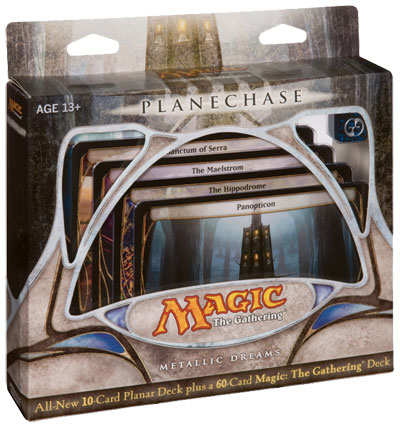
Centuries before the first tides of the Quicksilver Sea rose to meet each new sun, Mirrodin’s light shone on the golems alone…
While not directly tied to Mirrodin thematically, it would be impossible not to acknowledge the heavy imprint of that set and story upon the Metallic Dreams Planechase deck- a design which rests very heavily on the golems and their affiliated kin. Metallic Dreams is an uncommon thing- a deck which shies away from allegiance to and playstyle of any particular set of colours, instead choosing to both embrace and shun the coloured path on its way to victory. That may seem impossibly contradictory, but once you dig into the deck it begins to make perfect sense.
We’ll start our analysis of this most unconventional deck in a conventional manner, by focusing first upon its creatures and the role they play. As with Archenemy, Ertai’s Lament is less worried about the Planechase mechanic (planes, die, and all), but rather how the actual preconstructed deck itself plays out. The Planechase design proper can be lots of fun and has been covered extensively elsewhere- we’ll be looking at the deck.

A Glimpse of the Scars of Mirrodin Intro Packs Revealed!
Although we’ve sworn off any and all card spoilers for the upcoming Scars of Mirrodin, we’d be remiss in our duties if we failed to note the unveiling of the Scars preconstructed decks.

Look closely, and you can even see the colour combinations we have to look forward to. For a bit more information, you can check out the original “leak” here.
Duel Decks- Phyrexia vs The Coalition: The Coalition deck review (Part 2 of 2)

Eager to put The Coalition through its paces to see how well it performs, Sam and I broke out the Duel Decks and faced off for the customary three matches. Would the speed of Phyrexia run roughshod over the more intricate setup of The Coalition, or would I be able to bide time enough to bring my more powerful Domain and creature cards on-line? Here are the notes from the matches.
Duel Decks- Phyrexia vs The Coalition: Phyrexia’s Deck Review (Part 2 of 2)

To test the strength of the Phyrexia deck which, as previously reviewed is artificially limited but still capable of explosive growth, I challenged Sam who would pilot The Coalition. I gave Sam a briefing on the strengths and weaknesses of both decks, and on the importance of holding on and holding out until the midgame, when The Coalition’s strengths would come to the fore while Phyrexia’s early rush began to peter out. It would be a lesson far more easily said than done.
Duel Decks- Phyrexia vs The Coalition: The Coalition’s Deck Review (Part 1 of 2)

Like any high drama, Phyrexia vs The Coalition puts its heroes in something of an underdog role. Having set the stage for the villains- the Phyrexians with their mono-Black artifact-heavy deck- we now turn our attention to their foil, The Coalition. A five-colour deck under even the best of circumstances can have quite a task cut out for it, and by most any yardstick, a five-colour versus a mono-colour can indeed be quite the underdog.
This assumes a certain relative parity in power level, of course. A mono-Red deck featuring the very worst of the Goblin cards throughout Magic’s history will probably come up short against a five-colour control with full dual land suite. But as we touched upon in the previous column, the designers of this Duel Deck had to give particular attention to balance.
For the Phyrexians, this manifested in subtle “drags” on a traditionally rapid start: only two Dark Rituals, lots of mana sinks, etc. For The Coalition, it’s even more fundamental: it’s a five-colour deck.
We typically gloss over the lands in a particular preconstructed deck, because they tend to be very straightforward: here’s a big stack of X, a smaller stack of Y, and a singleton specialty land for variety. However, for The Coalition, the land is the perfect place to start, for without a solid grasp of the deliberate mana base any pilot will be at a severe disadvantage.
Duel Decks- Phyrexia vs The Coalition: Phyrexia’s Deck Review (Part 1 of 2)

“From void evolved Phyrexia. Great Yawgmoth, Father of Machines, saw its perfection. Thus the Grand Evolution began.” -Phyrexian Scriptures
The latest in a line of solid offerings from Wizards in the Duel Decks series, Phyrexia va The Coalition reaches back into the pages of history to present a virtual recreation of the epic battles between the two. A storyline that spanned years and blocks- something unheard of today- the set offers both a hefty dose of nostalgia as well as a very interesting pairing: mono-Black takes on Five-Colour Dominion.
Although it draws deeply upon the archetype with the inclusion of a few cards (Phyrexian Negator chief amongst them), Phyrexia is no Suicide Black deck. Rather, it provides a much more generalist perspective on Black and provides generous ways to win. As you might expect, this child of the “Father of Machines” is artifact-heavy, but as it typically the case with preconstructed decks, the burden of winning is borne on the backs of its creatures.

Puppets to Entertain Madness
“Let weak feed on weak, that we may divine the nature of strength.” -Phyrexian Scriptures
If you were to sum up the general philosophy behind the creature array in Phyrexia, you could do no better than that quote. Fielding 18 creatures (I’m including Phyrexian Totem here), over half of these are no mightier than a 2/2. And yet, what a splendid feast they offer, with a banquest most graciously well-stocked.
There are some that feed on others: the Carrion Feeder, Phyrexian Ghoul, and Phyrexian Broodlings all get bigger with the sacrifice of other creatures.
Still others feed on your opponent’s creatures. The Phyrexian Denouncer, Debaser, Defiler, and Plaguelord form a ‘cycle’ of sorts, bodies that can tap and be sacrificed to take out a target creature. The Bone Shredder does much the same, but through a different mechanic.
One feeds on your opponent’s hand (Order of Yawgmoth), while a few even feed on you! Both the Phyrexian Gargantua and the Colossus take bites out of your life total (the latter case quite severely), while the Negator (and it’s mimic, the Totem) require the sacrifice of permanents when damaged. The singleton Phyrexian Hulk can seem almost refreshingly tame by comparison.
When taken as a whole, the creature base follows a slightly deviant mana curve:

The very large bump in the three-drops may seem curious on first look, but when one takes into consideration the presence of two Dark Rituals in the deck, it makes perfect sense to have a solid lineup of threats that can be Ritual’ed out on the first turn for an immediate threat. Other noncreature spells and artifacts provide logistical support for the deck’s beaters.
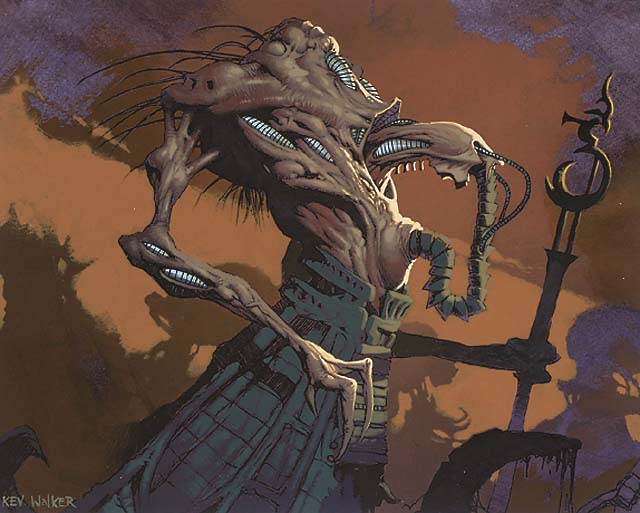
Phyrexia Wastes Nothing
“Ash is our air. Darkness our flesh.” -Phyrexian Scriptures
If the deck has a solid base of creatures (if a little weak in the front-end), it seems to falter a step in its support.
Perhaps the single biggest failing is the inclusion of only a pair of Dark Rituals. Half the joy of playing Phyrexia is gazing upon your opening draw and seeing if you’ve lucked into living the dream of a first-turn 5/5 Trampler. Not only that, but given the amount of viable first-turn plays (with a heavy concentration of 3-drops), it can only be considered a deliberate design element intended to limit the speed with which the deck can come out of the chute. I’m sure I wasn’t alone when I read about the decks before release, and wondered how on earth a five-colour deck was going to establish itself before being ripped to shreds by mono-Black. The answer, quite simply: weaken Black.
That isn’t to say that there’s not plenty of power here. Given all the sacrifice effects, it’s often delightfully easy to set up a hideously asymmetric Living Death, and an early Phyrexian Arena can give you jets in the early- and mid-game.
But many of the cards are either very loosely connected (read: thematically), or are in support of disparate strategies.
It’s a fine thing to include the monstrous Phyrexian Colossus, and useful to have alternate ways of untapping it (Voltaic Key and two Puppet Strings). But then you also have the clunky Hornet Cannon, which can be said to support cards with sacrifice effects, as well as the brutal Phyrexian Processor going down a completely different path. It’s almost as if you were privy to a clutch of Phyrexian generals areguing about strategy and tactics in the War Room, then threw in a few cards to support each strategy to keep everyone happy. It gets from A to B well enough, but has a tendency to weave about the road a little.
Topping it all off, there’s a smidgen of ramp (Worn Powerstone, the Totem), Equipment (Whispersilk Cloak and Lightning Greaves), card advantage (Phyrexian Vault), and a small portfolio of kills spells (a Slay, a Hideous End, and two Tendrils of Corruption).
Mono-black decks at their most effective tend to be tightly-focused things. You can be certain that the lack of focus here is a nod towards making the Duel Decks balanced against one another, which is not an unfair objective.
Here’s the full curve of the deck:
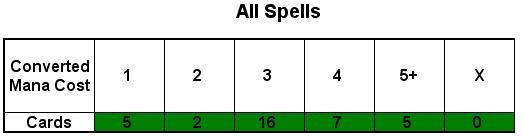
Ordinarily I’d probably put a Warning (Yellow) on the 16 3-drops in the deck, but two factors here speak against it. One is the aforementioned Dark Rituals, allowing for early threats. The other is because while the power level of the three-drops is moderate, there are a lot of mana sinks in the deck (primarily artifacts) that ensure your leftover mana does not go to waste.
Overall, the deck looks moderately effective when measured against wins/losses, but highly entertaining to play to those who enjoy the nuances of mono-Black (and who have the nerve to go all-in, as the deck can sometimes require). Join us next time when we pick apart the forces the Coalition has assembled, and see if they are up to the task up stopping the Phyrexians dead in their tracks.
Site Update: Archive Trap
Just a quick note here about a site update to the Archive Trap page. Our reader, Dave, recently suggested that we add in the Final Grade of each deck alongside the deck listing in our archives, so that they could be easily determined side-by-side.
We thought this was a great idea, and to make it easy on the eyes we’re unveiling a new ‘rating’ system for our Archive page. Next to the name of each deck is a rarity symbol corresponding to the particular set. These rarity symbols are based on the grade the deck was rated.
4.51 – 5.00 Epic
4.01 – 4.50 Rare
3.51 – 4.00 Uncommon
0.00 – 3.50 Common
It might sound confusing, but it looks easy- head on over to our Archives today and check it out. It will be a gradual roll-out, so not all decks will have symbols yet, but stay tuned!
Duel Decks- Jace vs Chandra: Chandra’s Deck Review (Part 2 of 2)

I have to admit before writing these reviews, when I’d played the Jace/Chandra decks (usually against other Planeswalker-based Duel Decks) I’d tended to favour Chandra’s construction. Although in my heart I’m a Blue mage, it took deconstructing Jace’s composition to really get a sense of appreciation for its intricacy. Indeed, I suspect I began to second-guess Chandra’s, and so it was with a keen enthusiasm that I threw down the gauntlet to Sam, and squared off to see if a Red blitz could power through her early stalling. Here’s how it unfolded:


 Ertai's Lament