

Mirrodin Besieged: Mirromancy Review (Part 1 of 2)
One of the landmark early theme decks released for 1998’s Stronghold was so staggeringly different from the precon decks of today that it’s almost hard to imagine a deck like it being produced for the modern game. The Sparkler was a Red/Blue deck best remembered for one defining characteristic- within its box you found a Mogg Fanatic, a Wall of Tears, a Wall of Razors… and nothing more. A grand total of three creatures. Of course, that left plenty of room for the burn (Lightning Blast, Shock), countermagic (Power Sink, Spell Blast) and general chicanery (Reins of Power, Intruder Alarm) and everything else. It was a bold and daring move, and created a very memorable and exciting deck.
It’s difficult to say whether or not you could get away with such a departure form the norm in today’s environment. Creatures in particular have come a long way since Tempest/Stronghold, and The Sparkler would certainly be under noticeably more pressure from the beefier modern beater. Most preconstructed decks have fallen into the familiar, comforting pattern of creature base with noncreature support. This formula is so entrenched in design that when a deck comes along that challenges it- even slightly- it’s a genuine occasion.

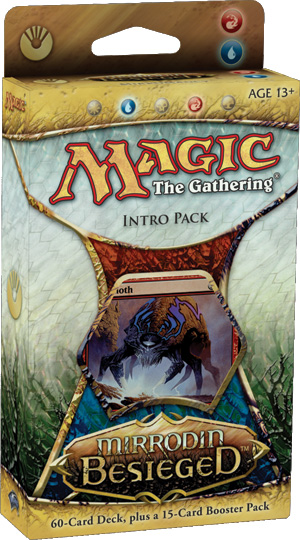
ManaNation Spoils Mirrodin Besieged Intro Decks
In case you missed it, ManaNation.com has published the full lists of all four intro decks for Mirrodin Besieged. You can check them out here!
Ertai’s Lament reviews of the decks will begin on 02 February.
Worldwake: Brute Force Review (Part 2 of 2)

At last, our final foray into the plane of Zendikar begins! Having now covered all three sets of the block, it’s time to say goodbye in fine form, and to do so we’ve settled in to play our last three matches for the review. Natually, I’ll be piloting Brute Force, while Jimi has taken it upon herself to pilot Mysterious Realms. We’ve enjoyed reviewing the block, and hope you’ve enjoyed the journey alongside us. Here are the game notes for this final confrontation.
Worldwake: Brute Force Review (Part 1 of 2)
One of our oft-repeated problem with Zendikar’s preconstructed decks has been that the core set content was far too high- when close to half your cards are from Magic 2010, it’s a bit harder to get a feel for how Zendikar’s supposed to feel. Our other major complain was that the set’s mechanics were underrepresented. There was landfall to be certain, and Allies were championed in The Adventurers, but traps and quests were so absent as to be scarcely recognisable as a theme, let alone a major one.
In some ways, Worldwake addressed these imbalances, as we’ll see in Brute Force, a Red/Green beats deck and our last stop in the world of Worldwake, though it would not be until Scars of Mirrodin that a very visible break in the set’s funadamental composition became evident.
Guest Meddling: Blades of Victory (Magic 2011)

Not too long ago, I started playing with a group of people at my college on Monday nights. About half the group was newer players, taking their first steps into the world of Magic: the Gathering. These new players ran the gamut in skill level and what cards they had available to them, but one thing remained constant-they all wanted to improve their decks.
Let’s be honest, it’s not very difficult to realize that, say, Bog Raiders and Canyon Minotaurs aren’t winning you any games (the exception being Limited, where both are decent picks, but that is an entirely different beast). However, I constantly find newer players asking for other people to make their decks better, and while I’m certainly all for helping people out, that’s no way to learn!
Today I am taking the M11 Intro Deck Blades of Victory and outlining some simple steps that can be taken to “pump it up.” More importantly, I’ll explain some of the reasoning behind each tweak, to provide a nice basic iullustration on “why this card is better than that one.”
Worldwake: Fangs of the Bloodchief Review (Part 2 of 2)

From the highs to the lows and everything in between, this match was set to be an interesting one. Jimi selected Flyover as her deck to pilot, while I of course were behind Fangs of the Bloodchief. With Flyover happy to get some early stall, would the aggressive Vampires be able to come out of the gate fast enough before Jimi’s aerial forces were able to marshal an effective counter? We sat down for the customary three matches to find out, and here are our notes.
Ertai’s Meddling: Deadspread (Scars of Mirrodin)

Thank you for joining us today as we release the next installment of the ever-popular Ertai’s Meddling series! Today we’re putting Scars of Mirrodin’s Deadspread firmly in our sights, and seeing if we can’t salvage what is a promising mechanic from the somewhat mediocre intro deck it’s been given. As ever we’ll be invoking the rules of Ertai’s Meddling, to make sure that our finished product is something fun and easily obtainable for everyone. That means:

Deadspread was the showcase deck for the new Proliferate mechanic, and had a lot of promise. Get some conters on the board, proliferate like crazy and finish off your decimated opponent. At least, that was the plan! As you might expect, the execution was perhaps a little shy of the mark.
So as we begin, what do we have to work with? Here are the strengths and weaknesses we identified in our analysis and playtesting of the deck:
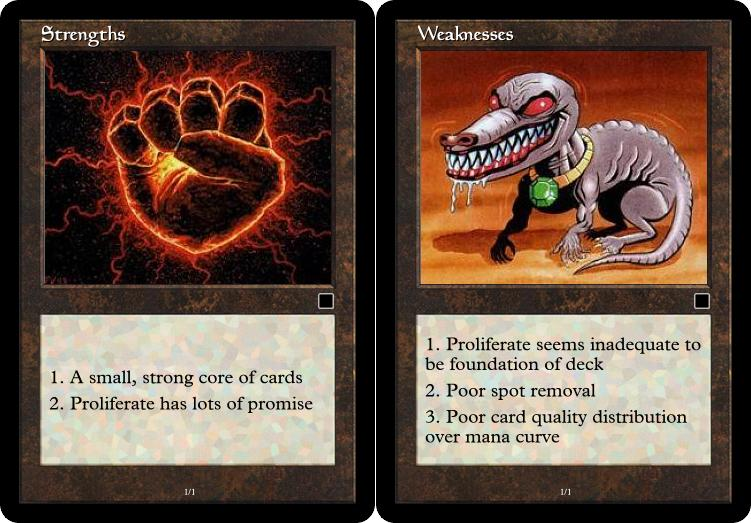
Here, too, are the raw materials that we have to begin with:

For this Meddling, we’ll be making one version of the deck. Frequently Meddlings in the past have made an improved version of the deck, then used its components to make a mono-coloured variant. This won’t work well for Deadspread– as the first set in a new block, it’s tools aren’t fully developed yet, and we need all the Proliferate we can get. A second deck could be made that would abuse all the charge-counter artifacts we have to play with, but for today’s purposes we want to arrive at a very tightly-focused proliferate deck that makes the mechanic work.
Worldwake: Fangs of the Bloodchief Review (Part 1 of 2)
Last August we began our review of Rise of the Vampires, the Zendikar Vampires-themed Intro pack, by noting that the tribe was something of a last-minute addition to the set. “The model was successful enough,” we continued, “that Wizards would go on to recur it in Worldwake, which featured an updated version of the concept.” Rise’s strategy was precisely what you’d expect from such a deck- a fast, aggressively-positioned creature rush backed up by removal to blow your opponent away before they had a chance to solidify a board presence.
Perhaps they grew weary, though, after having the sand kicked in their face one too many times, for Worldwake’s Vampires headed to the gym to beef up a little before being boxed up and shipped. Make no mistake- there are far more similarities than differences between the two, but there are differences indeed and they are telling. Although we’ll be reviewing Fangs of the Bloodchief, we’ll also be exploring how this deck diverged from the last, for therein lies the message of Worldwake: things are getting worse.
Worldwake: Flyover Review (Part 2 of 2)

In our previous column (Flyover Part 1), we approached the review from a different angle, breaking through the ‘fifth wall’ and presenting a review as seen from the inside. It was enjoyably received, but alas there’s little we can do comparably for the playtest segment of our review. Here, most everything’s transparent from the start!
To test Flyover’s aerial goodness, I was joined by Jimi, who had selected Brute Force as her weapon of choice. Here are the notes from our review.
Worldwake: Flyover Review (Part 1 of 2)

Every deck wants to tell you something. It seems obvious, but you’d be surprised how many people look through a stack of cards and don’t seem to pick up on what it’s trying to do. To be fair, it’s not always easy to see, but there are certain broad-based themes that can go a long way towards helping you grasp the concept behind a deck, and in today’s feature we’re going to do something of a meta-review. Not just a straightforward Ertai’s Lament review, but a breakdown of what we’re looking for, and how we arrive at the conclusions we do.
The subject of today’s deconstruction is Flyover, a Blue/White assemblage from Worldwake. Away we go!


 Ertai's Lament