

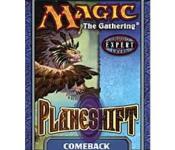
Planeshift: Comeback Review (Part 1 of 2)
Continuing the years-long epic story of the crew of the Weatherlight, 2001’s Planeshift was the second set in the Invasion Block. The Phyrexians had begun their invasion of Dominaria (the plane where much of early Magic’s worlds were set on), overlaying it with the plane of Rath to use as a staging ground. Gerrard and the surviving Weatherlight crew were in the thick of it, trying to battle back this most corrupting of evils, while Urza led a band of planeswalkers to confront Yawgmoth- leader of Phyrexia himself.


Dissension: Simic Mutology Review (Part 2 of 2)
Having come full circle, Sam and I prepared to do battle with the final matchup of the Dissension set reviews: Simic Mutology versus Azorius Ascendant. The Simic certainly have a stronger fleet of creatures, but would they be fast enough to prevent the defenses of the Azorius from becoming too entrenched to cross? We shuffled the decks and prepared to find out. Here are our match notes.

Dissension: Simic Mutology Review (Part 1 of 2)
As one might imagine, no city with any hope of long-term growth would do well without some institutionalisation of medicine, and so it is with Ravnica and the Simic Combine, as represented in the Simic Mutology deck. According to the Guildpact, the function of the guild is medicine and health, but over time this has… adapted… somewhat to include medical research and mutation.
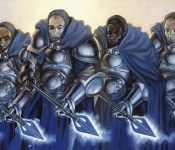
Dissension: Azorius Ascendant Review (Part 2 of 2)
Sam decided to operate a little out of her element and pilot Rakdos Bloodsport, the hyper-aggressive Red/Black deck against my Azorius Ascendant. Azorius was something of a trip through nostalgia-land for me, not because I was active in the game during Dissension (I wasn’t), but because my first decks at the dawn of the game tended to be White/Blue. Not so much the White/Blue Control archetype that we know today, but one that sought to enclose itself in an impregnable defense: Blessing, Moat, Circles of Protection, Farmstead and Ivory Tower were mainstays from White, paired with mainstays like Ancestral Recall, Counterspell, and Mana Short. Decks shamelessly ran past 100 cards, and constructing the perfect defense from which to hide behind and mess with my enemies was the crowning achievement of any game I was involved in.
Times have changed, and the closest I get to the Control archetype was with a Grixis/Cruel Ultimatum build. These days I’m most fond of Red and Black aggro builds. But from our analysis, I couldn’t quite shake the feeling that I was about to step back through time, after a fashion. Here are our notes.
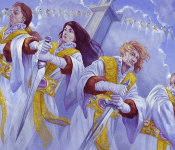
Dissension: Azorius Ascendant Review (Part 1 of 2)
For our next visit to the city of Ravnica, we’ll be looking today at the ruling body of the city- the Azorius Senate. Naturally, a city needs a governing body to function, and the Azorius guild is Guildpact-bound to maintain that duty. They don’t enforce the laws (that’s the job of the Red/White Boros Legion), but they do legislate them. To the Azorius, they are all that stand between Ravnica and sheer lawlessness and societal breakdown. To the common Ravnican, they are pompous windbags stuffed to bursting with overinflated self-importance.
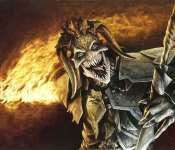
Dissension: Rakdos Bloodsport Review (Part 2 of 2)
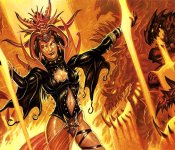
When last we left Ravnica, we were exploring the Red/Black aggro guild of the Rakdos, with their Hellbent ability. Hellbent, both thematically and mechanically, seemed a perfect fit for the guild, a sort of “all-in’s all in.” But as one so often finds in this game, what seems amazing on paper doesn’t always translate well to actually playing. Not only is this a lesson the brave unfortunates of the Great Designer Search 2 have been learning the hard way, it’s also an important one for us to keep in mind.
And so, to find out for ourselves just how well Hellbent- and the Rakdos- played out, we sat down to throw the customary three games. Sam was my opponent of choice, and she opted to go to battle under the banner of the Blue/Green guild, the Simic Combine.
Here are the match notes.
Dissension: Rakdos Bloodsport Review (Part 1 of 2)
Following the decline in the game that many felt Kamigawa had represented, with its insular mechanics and over-emphasis on flavour- 2005’s Ravnica brought Magic back into a new renaissance. Set in a compelling world of ten competing guilds in a massive cityscape (one for each possible two-colour combination), it struck a near-perfect blend of flavour and mechanics. A great many of the cards in the set were watermarked with a guild symbol for added depth of narrative, and each of the ten guilds were assigned their own unique mechanic. While most have faded to obscurity, even today you’ll still hear some Red/White decks describing themselves as “Boros” just as three-colour decks take their names from the Shards of Alara (Jund and Naya most commonly).
Tempest: Deep Freeze Review (part 2 of 2)

Reviewing Deep Freeze was a wonderful exercise in nostalgia for a deck and set that I have very fond memories of. If there was one thing that could top that, though, it was actually playing a game from that vintage set. Sam cracked open The Swarm, a Green-White creature-heavy deck, and we set about to recreating 1997 on our kitchen table. Here are our game notes.
Tempest: Deep Freeze Review (Part 1 of 2)
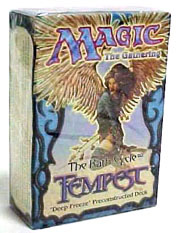
In 1997, a series of events occurred without which there would be no Ertai’s Lament. The first of these events- the overarching theme- was the release in October of the start of ‘the Rath Cycle’ with Tempest. Tempest is, to date, my favourite set, as enshrined, ensconced and untouchable as most any other long-lived memory (I was 22 then), and I had returned to the game relatively recently after taking a couple sets off.
I’d first started sensing something different with Magic during the Weatherlight set. I’d picked up a box of Mirage and Visions which, while intriguing, seemed as loosely-threaded as previous expansions of the game. But beginning with Weatherlight, Magic had the start of something new: a story.
Saviors of Kamigawa: Truth Seekers Review (Part 2 of 2)

In our last update, we deconstructed Truth Seekers and discovered that it was a deck built around a number of comes-into-play intercations with a healthy dose of lifegain to buy time for setting up the pieces. To see how it works in actual practice, I’ve enlisted Sam. It will be something of a ‘mirror match,’ as Sam has selected the G/W Spiritcraft deck (from Betrayers of Kamigawa).
Game One
Game one opens up with Sam winning the roll and dropping a Forest. Pass. I in turn lay down a Plains, and then one-up her with a Ghost-Lit Redeemer, and thus begins a slow but steady stream of creatures that would last much of the game. I play a Silent-Chant Zubera to match her turn 2 Loam Dweller. On turn 3 a slight pause as she comes in with the Dweller.
Not figuring her for any tricks this early, I gang-block with the Zubera and Redeemer, and she flashes a Giant Growth-like Kodama’s Might, sweeping both my valiant defenders to the dustbin of history.
Rebuilding comes right away, though, as turn 3 sees me replace my Ghost-Lit Redeemer and add a Shinen of Life’s Roar. (As an aside, had I known the value of the Redeemers to the deck I would never have put him in harm’s path, but that is part of the unique joy of learning a new deck with an interaction I had not caught).
My Zubera population doubles on turn 4 as another mighty Silent-Chant Zubera enters play. Given the “special bonus” that happens to these things for each Zubera in the graveyard that entered it this turn, I scratch my head and wonder what the point of the card is. Wrath protection? Sacrifice-effects fodder? It certainly seems to have little role in this deck, at any rate.
Nevertheless undaunted, I work the lifegain angle with the Redeemer for two a turn, until turn 6 sees Sam trot out a Kami of the Hunt. Given that most every Instant and Sorcery spell in these decks seem to be subtype Arcane, I vow to keep an eye on him lest he have something of a Kiln Fiend-like effect. My retort to her summons comes in the form of the Briarknit Kami, which will allow me to build up my creature force in much the same way- only permanently. Most everything I play now is making one of my critters even bigger.
I begin putting the pressure on in turn 7 as I play the Torii Watchward, and swing with my beaters. Sam’s now at 15, I’m at 24. Sam has the look of desperation as she coughs out another Loam Dweller on turn 8. Smelling blood in the water, I press my assault, using the Redeemer for an extra attacker rather than lifegain. Although I have Rune-Tail, Kitsune Ascendant in my hand, he won’t be the path to victory today as I slowly grind out a win.
There’s little glory to be had, however, as Sam has gone all 11 turns of the game without drawing a single Plains.
Game Two
The deck really comes alive for Sam in game two. Having solid land drops for four turns, she’s only able to squeeze out a Petalmane Baku but has threats in hand. Meanwhile I’m working on a Ghost-Lit Redeemer and Gnarled Mass. The Mass bites it almost immediately as Sam pumps the Baku with Kodama’s Might. Attacking in I smelled the trap but thought it a fair trade to pull that card out of her hand before she could start Splicing it to better effect.
I replace the Mass with Nikko-Onna, a serviceable 2/2, and Sam drops a Waxmane Baku to start the next turn. My turn 5 play is a Torii Watchward. By the end of the turn, we’re still both at 20 life (I’m actually at 21, thanks to the Redeemer and an early Baku attack).
Things heat up turn 6 as Sam aces the attacking Watchward with a Terashi’s Verdict, a sort of modified White Smother. I replace it with the stalwart Briarknit Kami. Next, Sam adds another Waxmane Baku. The first two Bakus are already happily sprouting ki counters, and another doesn’t bode well. The Petalmane, whose coutners convert to mana, isn’t much of a threat, but the Waxmane’s tap my creatures and can be used to blunt my aggression or even neuter my defense.
The next few turns are a flurry of back-and-forth, with little ground gained. A few creatures die going up over the trenches, but Sam is untouchable and meanwhile, thanks to the Redeemer and a well-timed Dosan’s Oldest Chant, I’ve crested 30 life. Although Sam has discovered the ki counters on those Waxmanes and is tying me up in knots by tapping my beaters, turn 11 sees me play Rune-Tail, Kitsune Ascendant and -snap- just like that, my creatures are indestructible.
Sam’s quit turtling and is pulling out all the stops with an Oyobi, Who Split the Heavens and the resultant 3/3 Spirit tokens it generates. By turn 12, it’s all I can do to cling on as she’s still at 20 and I’m circling the drain at 6. But the Briarknit Kami keeps pumping up my beaters with every casting, and her ki counters on those damnable Waxmanes can only last so long.
Tapping less and less, she’s only able to get me down to 2 (thanks to a game-saving Vital Surge) before I’m able to go all in and finish her off.

Game Three
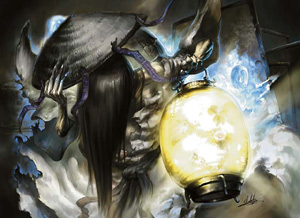
Sam takes the most aggressive position yet with a first-turn Lantern Kami, a wee 1/1 Flyer, and dropping a second on turn 2. I manage to get out a Moonwing Moth on turn 3 to defend, but she overruns it with Unchecked Growth. By turn 5 it’s already 20-11 in her favour, the Lantern Kami’s promising to make quick work of me if left unanswered.
Fortunately, turn 5 sees me lay down the good-as-gold Briarknit Kami, my MVP of the series, and thanks to a string of unbroken land drops I’m able to turn the tables a bit with a turn 6 Nightsoil Kami. I put the Briarknit’s counter on the Nightsoil, which is now 7/5 fresh from the bucket, and next turn swing back at Sam. Adding the damage to the nick she took from an earlier Nikko-Onna, Sam’s holding at 11 while I’m at 7. After the Kami’s bruising hit, I play the Torii Watchward, a card which has underperformed in the previous two games.
The next round Sam’s still flying in with the Lanterns, with a Kami of the Hunt and a Traproot Kami wall for defense. I catch a bit of a lucky break with the wall- it’s power and toughness are equal to the number of all Forests in play and we’re both playing Green, but between us we’ve only managed four so the wall is a temporary barrier at best.
Marshalling my forces, I Channel a Shonen of Life’s Roar onto Nikko-Onna to pull all blockers to her, which would leave my three beaters (pumped up by Briarknit tokens, as ever) to swing for lethal, but in a clever turn Sam blinks Nikku-Onna with Otherworldly Journey fizzling both my Channel and my plan.
Still, she takes 3 from the attack and is reduced to holding back her Lanterns as chumps. She’s dead a turn later.

Analysis
Truth Seekers was a fun deck to play overall, though I still have lingering doubts about its effectiveness, particularly if facing a fast, aggressive deck. It takes awhile to really build itself up, though once it does it offers a solid amount of flexibility along with some solid bodies to get there with. The lifegain can help in the way that all lifegain helps- it buys you extra time and little more. That said, the flip card Rune-Tail’s Essence effect will certainly punish an opponent who’s given you the luxury of too much time and life. In that regard, the deck works.
There’s a tremendous number of moving parts here when you take into consideration both the creatures’ abilities and the Splice effects. This is both good and bad, depending on the playstyle of the pilot. If you’re partial tointricate, interrelated abilities and effects then this deck will feel quite comfortable to you. If you’d prefer things to be more straightforward (or hate missing triggers or interactions), you may wish to give it a miss.
The block’s core mechanics are well represented here, and playing Truth Seekers will give you a very good idea of what the block’s flavour was. There’s a strong showing for Splice onto Arcane (which I love in part due to its inherent card economy), some Soulshift, a splash of Channel and a flip-card. Add into consideration that the precons in this set are for whatever reason- demand, print run, who knows- exceptionally cheap pickups on eBay, and you’ve got a dependable business-class ticket to visit the land of Kamigawa.
Pros: Solid representation of block mechanics; strong synergy between cards; above-average intricacy and complexity (that may be a con for others)
Cons: Back-heavy mana curve with little ramp support; direct removal almost nonexistent despite the splash of White (may be a characteristic of the block)
FINAL SCORE: 4.1/5.0


 Ertai's Lament